stories:
Q&A

Food Econ 101
Paul Roberts, the author of The End of Food, dishes on the food system
You might expect the author of The End of Oil and The End of Food to be gloomy and dry, but at a recent appearance in San Francisco (which you can listen to here), Paul Roberts was so candid and engaging that we wanted to hear more. While Roberts covered a lot of interesting details in his lecture—such as how the frenzy for McDonald’s Chicken McNuggets in the ’80s led to the breeding of freakishly giant-breasted chickens—we were most interested in the basics of food economics. CHOW spoke to Roberts about why our food system is breaking down and (despite his bleak book title) how to fix it.
Why has food been cheap for so long?
Generally, what we’ve done is we’ve increased the scale that we produce at. Rather than raise corn and pigs and vegetables on the same farm, we’re just gonna raise corn there. And that means that the whole farm can be devoted to corn, all the labor and expertise can be devoted to corn, all the inputs, all the tools you buy, all the machines you buy. So your costs will be much cheaper, so your cost per bushel will be much cheaper. So you have the economies of scale.
Why isn’t that working now?
You fertilize with nitrogen fertilizers and you get great increases in yield, but then you start realizing that you have to fertilize more and more intensively to get the same yield. You keep using pesticides, but now it turns out that you’ve got [several] weed species that resist Roundup, and so you have to come up with a new pesticide, or you have to figure out some new pest management method. We have a food system that was designed at maximum output and low cost, and now many of the efficiencies aren’t so efficient anymore … and that [system] was built for oil at $15 a barrel.
Why don’t you believe that local food systems are going to answer the global food demand?
There’s a limit to how much land area we have to devote to local food production. Land is really expensive when it’s close to cities. And local farms are often smaller, and small farms, as wonderful as they are for some things, don’t have the efficiencies that larger ones have for their economies of scale. So it’s sort of tough to imagine [them] feeding large populations.
So globally, it’s just not realistic?
There are countries that can’t produce enough food for themselves. So we need to ask: How do we make trade more effective and equitable and efficient? I think that there’s a lot of ideology flying around here: Let’s do local, not global; free trade is bad. There’s a lot we have to reverse, but you have to separate the moral argument from the pragmatic argument, and that’s hard to do. People are starting with things like food miles, which is an important start, but I think what’s starting to emerge is this understanding that food miles is too narrow. The argument I use is if I was to take produce from the Salinas Valley, load it into a freight car, and ship it to Seattle near where I live, that would be much more fuel efficient and have a smaller carbon footprint than would taking 50 pickup trucks, loading them up in farms around Seattle, and driving them into the farmers’ market downtown.
What are some of the constraints the food system is dealing with?
Forty percent of the calories that we make worldwide are directly attributable to the availability of cheap, synthetically produced nitrogen fertilizer. You make nitrogen fertilizer from natural gas, and natural gas is a cousin of oil, and that’s getting more expensive. Fertilizer costs have more than tripled in the past year.
And we’ve also got this really aggressive policy on biofuels. We can argue over exactly how much impact biofuels are having on [the] price [of food], but it’s absurd to believe it’s having a negligible impact.
And then there’s water: It takes a lot of water to make grain. You can find alternatives for oil and alternatives for fertilizer, but there is no alternative for water.
The last thing, of course, is climate. We’ve focused mainly on Africa, because that’s where we can already see climate’s impact on food output, but I think we really need to focus on what climate will do [to] the big food powerhouses like the United States. Even conservative climate scenarios show more drought and more flooding like we’re seeing in the Midwest.
Is there anything we can do about it now?
People who deal with food security long term are saying, “OK, this isn’t insurmountable. We’ve had food shortages before, and always we have come through because we’ve come up with new technologies and new business practices.” And the expectation is we’ll keep doing it, and this time we’ll have genetically modified foods to help us; that will be the big silver bullet. But the first step is to recognize it’s bigger and more complex than the challenges we’ve faced in the past, and that it’s far more complex than our current food policy reflects.
What are some of the solutions?
Part of [the solution] will require us making farming a more attractive profession. Farmers are leaving the farm, not because they hate farming, but [because] it’s just too hard [to make a living]. … In many cases, they can’t afford health care, so they need to have an off-farm job. So if you’re looking for these weak links, and you’re looking for ways to strengthen these links, then maybe finding a way to offer affordable health care to farmers would be one of those tipping points. But it’s not romantic; it’s not dramatic like some breakthrough seed.
Do you have any tips for things we can we do in the U.S. to lessen our impact on the food supply?
If you want to go meatless one or two times a week, or just reduce the amount of meat you eat, or go completely vegetarian in a thoughtful way, then that would be great. Understanding where your food comes from and seeing where you can make local decisions [when] it makes sense, but also understanding that not all local food is equal in terms of its impacts and its benefits. But both of those sort of bespeak a greater understanding of food.
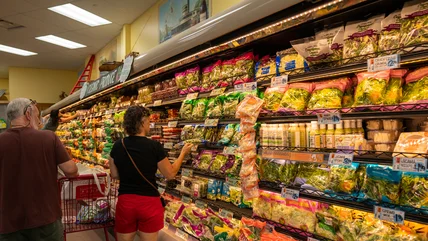
What I think consumers are really hungry for at this point, if you’ll excuse the pun, is an understanding of the economic forces that are shaping things. If you go into a grocery store, everything that’s there represents a business calculation. I think consumers need to begin to unpack and understand those business decisions: Why is that stuff here? You realize that all these decisions have massive consequences on the flavor and quality of our food, on the health impacts, the safety of the food supply, and, I think in the long term what we’re realizing is, on the sustainability of the food system.
So it sounds like you’re saying food can’t fit neatly into the capitalist model?
We definitely need markets and capitalism and free enterprise to do the things we need to do, especially going forward with all the new demands on the system, but we can’t just assume that the market by itself will do the right thing, because it won’t. And figuring out how to guide that market force, and how to manage and how to intrude where we have to, and how to regulate, that’s going to be one of the challenges going forward. And lawmakers won’t mess with it until they feel like consumers care.
How can we send that message?
If we started cooking again. We can’t all be farmers, but we can certainly start cooking again. Cooking is huge. It sounds really corny, but it’s not just about food and personal affirmation and sort of having a soul again, although it is all those things. Cooking was a way that households controlled the way that food came into the system, into the household, and the quality, and the cost. You controlled that by being the cook: You transformed raw ingredients, you planned menus, and you managed a sort of inventory, if you will—your pantry—all of which required us to be totally engaged with food, which we’re not now. If you just cooked, it would be this new signal. The market would say, “Wait a minute, I don’t have enough raw ingredients on the shelves now. I’ve got all this processed food, which suddenly you don’t want.” Not everyone’s going to suddenly start cooking every night, but if you cooked one or two more nights a week than you are cooking, it would be this massive signal that you sent up, and it’s the kind of signal that I think the market really needs to have.
Roxanne Webber is an associate editor at CHOW.
Photo-illustration by Sean McCabe


What a refreshingly balanced way to look at the problem. Thanks!
meat is murder
Don't feed the troll.
Economics 101 and common sense.
Economies of Scale, but there's diminishing marginal returns. Ultimately, aside from supply and demand, it comes down to greed and excess. We're so used to wasting food, and consuming more than what we should and what is optimal to avoid scarcity and shortage. We really have to start tempering our consumption to more manageable levels, especially since the population keeps on growing and countries like China and other developing nations begin to consume more than what they used to. There's only so much specialization in international trade can do to contribute to production and prices. If we don't lessen our consumption, we're inevitably going to face shortages and much higher prices. It's just the way of capitalism. Too much excess will be penalized with lesser quantities produced and higher prices in order to bring things back to an equilibrium.
Economics 101 and common sense.
Economies of Scale, but there's diminishing marginal returns. Ultimately, aside from supply and demand, it comes down to greed and excess. We're so used to wasting food, and consuming more than what we should and what is optimal to avoid scarcity and shortage. We really have to start tempering our consumption to more manageable levels, especially since the population keeps on growing and countries like China and other developing nations begin to consume more than what they used to. There's only so much specialization in international trade can do to contribute to production and prices. If we don't lessen our consumption, we're inevitably going to face shortages and much higher prices. It's just the way of capitalism. Too much excess will be penalized with lesser quantities produced and higher prices in order to bring things back to an equilibrium.
I think Roberts is right to say that "moral" solutions are inadequate...however, I'm a bit puzzled by this: "We definitely need markets and capitalism and free enterprise to do the things we need to do."
Sorry, but why? I'm not convinced at all that any system that refuses to see food as a basic human right can ever stamp out hunger or produce quality food in an environmentally friendly way. As all the statistics tell us (from the UN, Oxfam, etc), there is more than enough food produced to feed every person on the planet today. The Food and Agriculture Organization (FAO) of the UN reports that enough food was grown last year to give every single person on the planet 2,800 calories per day.
In other words, the reason people are going hungry, whether around the globe or here in the U.S. is not due to a lack of food, but due to their inability to afford to purchase it--and that is very often directly attributable to the market system.
And this is very often the case--that modern famines are very seldom "natural disasters", but in fact produced by the logic of a system which says that countries should export food for sale on the world market, rather than feed their starving populations. (It's no secret that food was being exported from Ireland during the Great Famine.)
"Capitalism" has also done some pretty horrible things more recently in terms of food to countries like Haiti, Mexico, etc...where their economies have been battered open by IMF/World Bank and NAFTA policies, forcing them open to cheap imports of U.S. corn and rice, decimating the local farming industry. Now, when prices of staples like corn and rice are surging due to commodity speculation, the falling dollar, the ethanol boondogle, etc., the populations of those countries that were forced to open their economies to the "free market" are suffering immensely.
So while this is an intriguing interview, I don't understand at all why markets are any part of the solution to feeding those who are hungry. I think Francis Moore Lappe and Raj Patel, who talk about the need for increased democracy and the building of social movements around the question of food, are much more on the right track in terms of hitting on a real solution--one that goes beyond a individual, moralistic approach ("go vegetarian", "grow a garden," etc.)
effective birth control needs to be included in the mix; a big part of the problem is that there are just too many people.
I totally agree with nicolson's post above. NAFTA and "free" trade in general have added to existing food woes and created greater ones. The fact that food is NOT seen as a right for all is shockingly awful.
The daily nutrition and calories of people on this planet should not be subject to the needs of the marketplace. Of course things like champagne and caviar are not rights, but rice and vegetables are. It is nothing but a horrible crime that some eat way more than they need while others starve because the price of oil surges. I don't want the World Bank deciding who eats and who starves.
Again, as nicolson says, this is not going to be solved individually, moralistically or economically (business-wise) because so many cannot make the decision to give up meat one day a week because they NEVER have meat.
It's also a problem that's hidden away. Of course we see disturbing news footage of folks with distended bellies or gaunt faces and stick-thin arms in Africa and elsewhere, but then we turn off the TV and sit down to a delightful dinner, with maybe a glass of wine.
End of rant.
He makes some very good points, but fails to mention other solutions include growing your own food. By reducing the dependency on farms it will reduce household costs.