stories:
Gear
![]() |
French-Fried NirvanaDeep-fat frying at home |
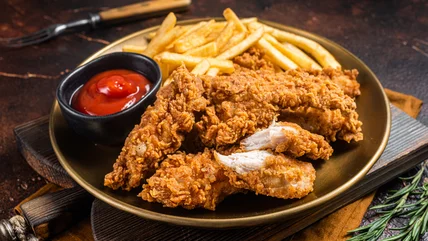
For many people, French fries are a guilty pleasure, yet restaurants mostly peddle ones that are grease saturated, limp, and trans fats laden. In fact, there are probably a lot of people who’ve never had a good fry. Those who know will tell you: A well-fried fry is a transcendent experience. It’s crispy on the outside, tender and fluffy on the inside, and fresh and potato-y tasting.
The keys to getting fries right, along with corn dogs, elephant ears, samosas, and other deep-fried foods, are timing and temperature. You must fry hot enough so that the oil doesn’t saturate the food, and just long enough that a crust forms. And although they may not fly as spa cuisine, when fried correctly, these foods are not necessarily soggy sacks of gut-bomb grease. New home-frying gear gives you this level of control. And it also means you can use your own vegetable oil and avoid worrying about trans-fats. Not all restaurants fry in the heart-unhealthy oil, but if you’re eating from the drive-through, chances are it does.
“Why do I need special frying gear, when I could fry in a pot?” you ask. Because pots are wide at the bottom, require too much oil, and sometimes warp in the high heat needed for deep-frying. You could use a normal wok, like the ones used in many Chinese restaurants, but most woks are wobbly and unstable on a burner. Not a big deal when you’re making stir-fry, but scary when you’ve got a pot of bubbling-hot oil.
I tested two of the best pieces of frying equipment available for the home chef. The first is a cast iron wok from Lodge, which, though not marketed specifically as a deep-fryer, works great as such. The other is an electric deep-fryer from Euro Pro. In both, I made classic Belgian fries. These are the twice-fried, thicker-cut variety. You fry them once just to cook them through, then get the oil hotter and cook them again to make them crisp. Using vegetable oil and russet potatoes sliced into 1-centimeter sticks, soaked in water, then dried very well, I heated vegetable oil to 350°F to cook through, then 375°F to crisp. I used an infrared thermometer to make sure I was getting the right temperature of oil in both units.
Pro Logic Wok
By Lodge Manufacturing Co., $69.95
The beauty of the Lodge cast iron wok is that it’s heavy and solid, so you don’t have to worry about it rocking on the stovetop. The wok is part of the company’s newer Pro Logic line of cast iron pieces, which come preseasoned and ready to use right out of the box.
I filled the wok halfway with oil and heated it on my gas burner over a high flame. With an infrared thermometer, I monitored the oil temperature until it reached 350°F, then carefully added a handful of raw fries. I cooked them in batches for about seven minutes until they were limp but still pale, took them out to cool, and then cranked the heat until the oil reached 375°F. The fries went back into the oil bath, where they turned golden and crisp in about 90 seconds.
The cast iron maintained heat well, but it was necessary to monitor the temperature constantly with a thermometer, as there was no other way to tell how hot the oil was. This isn’t necessarily a deal killer—many people like to use a thermometer when frying, anyway. The wide mouth and deep bowl offered easy access with minimum spattering, but the open pan released frying smells freely into the air. The pan must be washed by hand—like all cast iron, it needs special care.
4L Triple Deep Fryer (K4318)
By Euro-Pro, $79.99
The Euro-Pro 4-Liter Triple Deep Fryer is for serious jobs. For one thing, it comes with three frying baskets—one large, plus two smaller snack-sized ones. The main benefit of baskets is that there’s no fishing around for food in hot oil with a slotted spoon—just pull them out when everything’s done.
The unit plugs in and doesn’t need a burner, which means you can use it on your terrace and eliminate indoor frying smells. It’s only about the size of a big toaster—9 inches wide by 11 inches long by 16 inches deep. The lid’s got an air filter and a clear glass window that lets you keep your eyes on the fries. The power cord snaps on with a magnetic breakaway connection that easily comes apart if the cord gets yanked. (Imagine knocking over a deep fryer—the horror!) And everything but the control panel/heating element is dishwasher safe, which means you can break the whole thing down and jam it in the dishwasher.
One other important feature allows you to set the temperature of the oil rather than having to use a thermometer. I used mine just in case, however, to make sure the settings worked. They did.
To test, I filled the oil container and set it to heat to 350°F. When the ready light went on, I lowered a half-full basket of raw fries into the oil, cooked them a few minutes, took them out, and reset the temperature to 375°F.
I finished the fries by putting half in one of the smaller baskets and the rest in the other. That way, I was able to take one basket out earlier for my sister, who likes her fries less crisp than I do. She was quite happy with her batch, as I was with mine. The latter were extra-crispy, golden, and well done. And it was fun to watch them through the little window while they were cooking.
The unit’s built-in thermometer made the frying process much easier, as it self-adjusted during cooking. But the metal parts on the sides got too hot to touch (they are supposed to stay cool). The filter on the lid also did little to absorb odor, but its snug fit—with silicone gaskets around the basket handle openings—minimized oil leakage. Being able to stick almost everything in the dishwasher offered another huge convenience, with no oiling or drying necessary.
Deep-Fry Convert
After testing these products, I don’t know why I never got deep-frying equipment at home before. The wok was stable and easy for small jobs: say, inviting a friend over for moules frites. My sister and I agreed that we were definitely busting out the electric deep-fryer for our annual Chinese New Year’s party to make egg rolls. Only, weather permitting, we’re going to do it outside.


The problem that I have with deep-frying at home is that, if cooking for just one or two people, its a real waste of oil. Even using one of the specialized fryers you must end up using an entire bottle of oil.
I've heard mixed things about storing and reusing deep-frying oil...although it seems to me like its probably not a good idea.
If you can strain your oil a few times through a fine sieve (lining the sieve with a coffee filter for the last straining is especially helpful), you can get a several uses out of it. But it also depends on which oil you're using and what you're frying--if you just did a bunch of fish or onion rings, the oil will have absorbed a lot of those flavors and won't be good for much else. Also, if the oil you've used has a lower smokepoint, (like pure olive oil) it might be good only once.
Basically if the oil is really dark or smelly, it's done. By the way, it's best to strain frying oil while it's still hot, so be very careful and make sure you're straining it into a heatproof container or pot.
Also, if you have a lot of extra used oil, post it on Craigslist and someone with a biodiesel car can come motor it away! Think of it as symbiotic relationship. (You get fried foods at home, they get "gas.")
Now I know how to recreate my favorite Scottish delicacy-- deep fried mars bars (in batter ; )
The one thing that has always kept me away from deep-fat frying is how to dispose of the oil (apart from finding someone with a biodiesel car). Any suggestions?
I fry foods way too often. I've gone through many fryers, trying to get one that doesn't drop in temp drastically whenever I put the food into it. I currently have the WaringPro version of the EuroPro reviewed here. It takes a gallon of oil to fill it, but that's a good thing. The more oil, the better it'll hold it's temperature when you add food. But even with that, it will drop in temp 70+ degrees when I put in 1/2 pound of room temp french fries. The metal is so thin, it has no heat retaining capabilities. And, I don't think those coil heating elements are very powerful. I investigated some commercial electric fryers, but at $450 each, that's a bit expensive for french fries.
The best solution I've found so far is my cast iron dutch oven. The iron retains the heat very well, so that when you add the food the temp doesn't drop so much. And I find cast iron easy to clean and maintain.
I filter my oil through a flour cloth when it cools enough, and return it to the gallon container it came in. I'll replenish it with fresh oil from time to time as needed, and when it gets dark, after about 5 uses (I don't fry fish much), I'll dispose of it in the same container and start with a new one. I use peanut oil exclusively.
Pearl River Mart sells a heavy cast iron wok for about 15$.
I have a Tefal deep fryer that appears to be identical to the Euro Pro. If not, then it certainly has pretty much the same design. It adds an oil cleaning feature that (to my surprise and delight) really works.
The unit is a few inches taller than the Euro Pro. Under it is a large plastic oil container. When the unit cools after a frying session, it automatically drains into the sealed oil container below. The filter is very effective. You can either store the oil container in the unit or store it in the fridge. The first option is much more convenient, while the second prolongs the life of the oil. Having the choice is useful. Note, though, that the full plastic container is heavy and unbalanced, so you must move it carefully to avoid dropping it.
When you next use the unit, you unscrew a cap and pour the oil back into the frying chamber. It takes a bit of concentration to avoid spilling, but it works effectively.
Frying performance is excellent and it heats and recovers quickly. I would be happier with some insulation in the unit's walls (both for safety and for heat retention), but it works well as it is. Although it seems that heat might dissipate too quickly through the thin walls, it actually takes a couple of hours for the oil to cool completely when the heat is turned off. Everything but the electrical parts can go into a dishwasher.
In short, this is a really innovative design that works very well. Its ongoing durability is, of course, unknown.
The need to carefully avoid spilling oil from the plastic container is a nuisance, but this unit is so much easier to clean and maintain than any other I've seen that the tradeoff, to me, is a no brainer. Making the oil container more solid would make it less finicky to use without spilling, but would also add weight without improving performance.
The outside stays cooler than I expected while in use, though you can't really call it a "cool touch" device. The viewing window stays clear when frying most foods and the grease/odor filter is adequately effective. The safety features are very good. The magnetic power cord is annoyingly easy to disconnect, but I recognize that it serves as important safety device.
In short, this is the best consumer-level deep fryer I've ever seen. However, it does require a huge amount of oil and significant storage space if it can't sit on your counter. I paid about $70 (Can) on sale in Toronto.
A warning on that Euro-Pro fryer. Most of the plastic parts will turn brittle, crack and fall apart. The base, and the controller housing are a mess on mine. Still works very well, but looks awful.
You can reuse fat, and you DO NOT need to strain for french fries, plain wings, or other things that don't leave behind little particles.
You can dispose of the leftover fat in the garbage, just use a container. Or you can mix it with a lot of detergent and hot water, then run it down the drain.
If you want to go really pro, look at CostCo for the big boxes of "Fry King". It's fat specificly for deep fryers and will last a LOT longer than the liquid veg oils home cooks use. Looks like a giant block of Crisco wrapped in heavy plastic put in a cardboard box. I'm sure it will lead to an earlier death (I think it's based on beef fat?), but it works very well.
Thanks for the comments and caveats.
About the oil - yes, you can normally re-use it. It depends on the kind of oil, what you've fried, at what temp, for how long, what you intend to fry next, etc. - but yes, normally you can re-use the oil. Let's say with vegetable oil, potatoes, for fries, average/not-Supersized batches - you can re-use the oil about 8-10 times, but use it about within a month.
WAIT UNTIL THE OIL HAS COOLED. I don't care what psycho fry cook says it's better to process it hot. I've seen what happens when a pot of hot oil pours onto a live human foot - not pretty.
Pour the oil through a mesh sieve first - a paper coffee filter if necessary. And if you buy the oil in those gallon-ish sized jugs, just re-use those for storage. Stick it in a cool, dark place but in the fridge if you have room.
When it's really done - and you'll know if it's dark, smelly, etc. - yes, do try to recycle it - google your local biodiesel users and/or recycling centers. Or ask a local restaurant with a grease bin out back if you can add yours - their grease does get recycled but restaurants actually have to pay for removal so ask nicely. Or you can compost it. If you need to throw it away, pour it into a sealed container and throw it in the trash. The last thing you want to do it wash it down the drain - not economical nor efficient and it can build up and clog your pipes - environmental karma's a bitch.
Restaurants often use a commercial filter and sometimes a filter powder to remove a maximum of impurities and lengthen the life of the oil.
If you use the Euro-Pro - or any other fryer with an immersed heating element - do not use solid fat. It will melt from below and possibly explode through the solid top layer of fat.
BTW my old French chefs always said horse fat was the best for frites - that with a side of horse tartare.
Hey, why use a wok at ALL? Use a dutch oven. Woks are basically useless, my friends. USELESS. The Chinese have invented practically everything of use in this world, from fireworks and dumplins, but throw out yer wok. It's useless for home cooks.
Monkey Man Jake - I can understand - and even accept - your preference for a dutch oven over a wok for deep-frying. But throw it out? It's useless? Are you sniffing fumes or what? True you don't get the same bad-ass heat from most home burners as you do in Chinese restaurant kitchens, but the curved bowl of a wok is still more efficient for stir-frying. And just try pouring a few cups of oil into a dutch oven compared to a wok. You get more depth in the center of the wok - which is just enough to deep-fry small amounts - while you're just sauteeing in a dutch oven.
Next thing you know you're going to be crazy-talking about pitching the chopsticks. If you were in my kitchen, I'd make you deep-fry in a wok using those extra long frying chopsticks.
I save my oil in the fridge, in a little stainless steel oil canniser with a filter screen on top. However, I filter it through a Chemex filter paper and my Chemex coffee maker. The re-used oil is only for vegetables frying, no meat products. My mother used to say that frying potatoes would clean up the oil, recently I've heard that frying some slices of apple help. I cna tell you that the potatoes trick doesn't really work.
I compost my used oil, actually I just pour it on the ground in the back yard. It isn't a petroleum product and will break down just fine without harming anything.
Jeffrey Steingarten, I believe agrees that the best frites are made with horse fat. Sometimes I can get goose fat. It is so expensive, however, that I cook frites the way they do in Greece--iput some in a small fry pan and do small batches at a time. A vcross betw deep=frying and sauteing. Steingarten also says that Joel Rubochon, while cooking at home, also puts uncooked frites into a kettle at room temp; when the oil reaches 375 the frites are done. Ive done this many times and it is very good. Does anyone know what oil the street vendors of frites in Amsterdam use?
Finally, my grandmother cooked hand-cut fries in small, deep-boiler with a basket. She always used lard or bacon drippings and the results to a teenage boy were fantastic.
Why not Use Tallow, Beef fat? That's what McDonalds used to use years ago. Even when they switched to Trans Fat rich shortning they still added a Beef fat artifical flavor. Till the Hindus found out and Raised cain Taking them to court. Just ask your butcher for it. In Japanese markets you can still get small chunks, It's used for starting Sukiyaki.
I've made fries in goose fat (I occasionally roast a goose to give me an excuse to render the fat), duck fat, and beef tallow, and while goose and duck fats can tolerate a higher temperature, beef tallow really adds a great flavor to the fries. I render beef tallow when I make beef stock.
Bear in mind that they used to make candles out of tallow, because it catches fire very easily. If you fry in beef tallow, be sure there is plenty of space at the top of the fryer or the pot for the fat to boil up without boiling over when you put in the food and be prepared to turn off the fire and have a fire extinguisher close at hand in case of a mishap.