<?xml version="1.0" encoding="UTF-8"?>
<item>
  <id>12310</id>
  <title>Cabbage and Dumpling Soup</title>
  <total_time></total_time>
  <active_time></active_time>
  <serves>Serves 6 to 8</serves>
  <published_at>Wed Aug 06 01:03:14 -0700 2008</published_at>
  <updated_at>Tue Feb 03 02:36:33 -0800 2009</updated_at>
  <difficulty></difficulty>
  <cuisine></cuisine>
  <type>Licensed</type>
  <link>http://www.chow.com/recipes/12310</link>
  <pubDate>Tue, 03 Feb 2009 10:36:33 GMT</pubDate>
  <short_description></short_description>
  <long_description></long_description>
  <introduction>
    <![CDATA[<p>It was in the old capital of the Black P&eacute;rigord, in the town of Sarlat, that I first heard about <i>miques</i>&mdash;enormous dumplings poached in soup to give added substance to a meal. <i>Miques</i> are traditional peasant fare in the P&eacute;rigord, Quercy, and Corr&egrave;ze and are, therefore, considered a homey accompaniment to soup.</p>
<p>These dumplings can be made with stale bread, with a mixture of cornmeal and flour leavened with yeast, or with a type of brioche dough flavored with garlic, parsley, and pork cracklings. Like bread, <i>mique</i> is served after the first helping of broth, along with the meat and vegetable portion of the soup. In the P&eacute;rigord, it is usually moistened with broth, while in the Corr&egrave;ze the brioche-style <i>mique</i> is generally served dry. Leftover <i>mique</i> is saved, sliced, and fried the following day, either with bacon and eggs or sprinkled with sugar and served as dessert.</p>
<p>I&apos;ve eaten brioche-style <i>mique</i> with chicken in red wine, with a civet of rabbit, and even, in one home, simply doused with tomato sauce. My hostess, rather than cut the <i>mique</i> with a knife or with a string the way you might cut polenta, actually broke up the dumpling with two forks to show how light it was.</p>
<p>The <i>mique</i> is a good way to approach an understanding of the earthy country cooking of Southwest France, a perfect example of its purpose, which is, of course, to fill the diner up. The <i>mique</i> of Sarlat, fondly nicknamed <i>nuages pesants</i> (heavy clouds), is made from stale bread, bacon bits, and eggs and leavened with baking powder. It is served with a sparerib soup and assorted vegetables, and if the pot is big enough and the family prosperous enough, a veal knuckle or a chicken may be added, too.</p>
<p>I asked a friend who was born in Saint-Cyprien (a neighboring town to Sarlat) to find someone who could teach me a typical <i>mique</i>. She took me to a woman who taught local cooking to city people who owned vacation houses in the region, and here I confronted the classic difficulty of a food writer conducting field research in provincial France.</p>
<p>Madame X had a pointed chin and pointed ears, a tiny mouth, short-cropped hair, high cheekbones, and a typical square P&eacute;rigourdin face. She was a quintessential peasant woman who loved to talk about cooking, worked hard for very little money, and was fiercely loyal to her family. On the other hand, she was obsessed with the notion that she must guard her &ldquo;culinary secrets,&rdquo; suspicious of my interest in her knowledge, and totally confident in her ability to deceive. She did try to hide the &ldquo;secret&rdquo; of her <i>mique</i> and got caught in her own trap. Though her soup was delicious, her <i>mique</i> barely rose (<i>miques</i> generally double in volume). Her own family, sitting there at the table, complained about its size and less than marvelous good taste. She pretended not to hear one word and gobbled up her portion.</p>
<p>Still, the experience was fascinating, an insight into the cult of recipe secrets and into the lifestyle of a peasant family. The kitchen was in a wonderful stone building with a fireplace in the center. While we waited for the soup to cook and the <i>mique</i> to rise, we grilled chestnuts over the fire. Her husband came in and washed up; he had just finished force-feeding a dozen geese. One by one, the children returned home from school, changed their clothes, and proceeded to do chores around the house. During this time, while we were together, Madame X bombarded me with a confusion of advice, all sorts of theories about temperatures and cooking times, her subterfuge sprinkled with a little bit of peasant feminism. Actually, it was fun to fence with her and to watch her cook&mdash;she was really very good.</p>
<p>When the dough was ready to be cooked, she removed the chicken from the soup, explaining she had to make room for the <i>mique,</i> give it space to expand. I liked the way she slipped the <i>mique</i> into the pot along with the floured tea towel in which it was wrapped. She then pulled the towel out gently, covered the pot, and let the dough cook in the simmering liquid. After about 25 minutes, she turned the <i>mique</i> over and let it cook some more.</p>
<p>The recipe presented here is not Madame X&apos;s, since her <i>mique</i> did not turn out particularly well. My friend from Saint-Cyprien went about finding another teacher for me. This time it was a lovely lady in her late seventies, Madame Marthou, who quietly prepared this wonderful cabbage, sparerib, and <i>mique</i> soup. The <i>mique</i> in this recipe is a stale-bread dumpling with bacon, garlic, and herbs, flavored as is the custom in Saint-Cyprien.</p>]]>
  </introduction>
  <instructions>
    <![CDATA[<ol>
	<li>About 4 hours before serving, put the meats in a stockpot and cover with cold water. Bring to a boil over high heat; boil for 5 minutes; then drain, rinse under cold running water and drain well. Return to the stockpot.</li>
		<li>Add fresh water to cover and slowly bring to a boil. Skim off any scum that rises to the surface, then partially cover and simmer for 1&frac12; hours. Remove from the heat and let the meats cool in the soup so that excess fat can be removed easily; if this is not done, the soup will be too greasy.</li>
		<li>Meanwhile, prepare and refrigerate the mique as described in the recipe that follows.</li>
		<li>Bring the soup with the meats to a boil. Add the cabbage, carrots, turnips, leeks, and garlic. Reduce the heat and simmer, partially covered, for 1 hour.</li>
		<li>Remove 1 cooked carrot and 1 turnip from the pot. Slice them and brown in the fat in a small skillet over moderately high heat for about 5 minutes. Return this fricassee to the soup.</li>
		<li>Slide the chilled mique, still loosely wrapped in cheesecloth, into the soup. It should be submerged; if necessary, add a little boiling water. Cover and simmer over moderately low heat for 45 minutes. Do not uncover while the mique is cooking.</li>
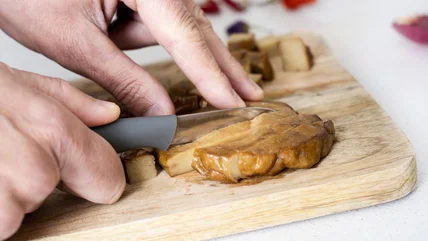
		<li>Transfer the mique to a plate. Drain off any cooking liquid and let rest for 10 minutes. Remove the cheesecloth. Halve the mique, then cut it into slices.</li>
		<li>Slice the meats and vegetables and divide them among heated soup plates. Add a thick slice of mique to each plate and moisten with a ladleful of cooking broth. Serve at once, with a grainy mustard and French cornichons.</li>
		<li>In this recipe, the leftover cooking liquid is not served as a separate soup.</li>
		<li>Boil the soup until reduced to 3 tablespoons. Remove from the heat and let cool.</li>
		<li>Break the eggs into a shallow bowl. Sprinkle just enough salt over the yolks to create a thin veil, about &frac12; teaspoon. (This is Madame Marthou&apos;s truc for adding just enough salt to a stuffing.) Beat the eggs to combine.</li>
		<li>In a medium skillet, cook the chopped bacon with 2 tablespoons water over moderately low heat until all the water has evaporated and the bacon is half crisped, about 5 minutes.</li>
		<li>Remove the bacon with a slotted spoon; reserve the warm bacon fat separately. Deglaze the skillet with the milk and reduced soup liquid and gradually whisk into the beaten eggs. Add the still-warm bacon fat and beat lightly to combine. Mix in the herbs, garlic, and pepper to taste.</li>
		<li>Gently and thoroughly blend the egg mixture with the bread cubes in a large bowl.</li>
		<li>Put the flour and baking powder in a strainer set over a plate. Shake one third of the flour mixture over the moistened bread cubes. Swirl the bowl so cubes are tossed with the flour and become coated evenly. Repeat with half the remaining flour and baking powder and swirl to combine. Sprinkle the bacon into the bowl. Add remaining flour mixture and swirl again to keep the mixture as light as possible.</li>
		<li>Fold a large piece of cheesecloth (about 24 by 36 inches) in half to 24 by 18 inches. Lightly brush with oil. Gently press the mique mixture into a mound and place on the oiled cheesecloth. Wrap loosely to allow for expansion, because the mique almost doubles in size when cooked. Tie the ends of the cheesecloth with string. Set the mique on a plate and refrigerate for at least 30 minutes to allow the bread and flour to absorb the moisture.</li>
	</ol>]]>
  </instructions>
  <img>http://www.chow.com</img>
  <author>Paula Wolfert</author>
  <category>
    <id>50</id>
    <name>Main</name>
  </category>
  <ingredients>
    <ingredient>
      <ingredient_id></ingredient_id>
      <description>
        <![CDATA[<p>1&frac12; pounds meaty salt pork</p>]]>
      </description>
    </ingredient>
    <ingredient>
      <ingredient_id></ingredient_id>
      <description>
        <![CDATA[<p>2 pounds meaty spareribs</p>]]>
      </description>
    </ingredient>
    <ingredient>
      <ingredient_id></ingredient_id>
      <description>
        <![CDATA[<p>1 small veal knuckle</p>]]>
      </description>
    </ingredient>
    <ingredient>
      <ingredient_id></ingredient_id>
      <description>
        <![CDATA[<p>1 onion, halved, 1 half stuck with a clove</p>]]>
      </description>
    </ingredient>
    <ingredient>
      <ingredient_id></ingredient_id>
      <description>
        <![CDATA[<p>Herb bouquet: 6 sprigs parsley, 2 sprigs fresh thyme, and 1 small imported bay leaf, tied together with string</p>]]>
      </description>
    </ingredient>
    <ingredient>
      <ingredient_id></ingredient_id>
      <description>
        <![CDATA[<p>The <i>Mique</i> (at right)</p>]]>
      </description>
    </ingredient>
    <ingredient>
      <ingredient_id></ingredient_id>
      <description>
        <![CDATA[<p>1 pound savoy or green cabbage, halved and cored</p>]]>
      </description>
    </ingredient>
    <ingredient>
      <ingredient_id></ingredient_id>
      <description>
        <![CDATA[<p>5 carrots, trimmed, peeled, and left whole</p>]]>
      </description>
    </ingredient>
    <ingredient>
      <ingredient_id></ingredient_id>
      <description>
        <![CDATA[<p>4 medium turnips, peeled and left whole</p>]]>
      </description>
    </ingredient>
    <ingredient>
      <ingredient_id></ingredient_id>
      <description>
        <![CDATA[<p>3 leeks (whites and pale green parts), rinsed well and tied in a bundle</p>]]>
      </description>
    </ingredient>
    <ingredient>
      <ingredient_id></ingredient_id>
      <description>
        <![CDATA[<p>1 garlic clove, halved</p>]]>
      </description>
    </ingredient>
    <ingredient>
      <ingredient_id></ingredient_id>
      <description>
        <![CDATA[<p>1 tablespoon rendered goose or duck fat</p>]]>
      </description>
    </ingredient>
    <ingredient>
      <ingredient_id></ingredient_id>
      <description>
        <![CDATA[<p>Grainy mustard and cornichons</p>]]>
      </description>
    </ingredient>
    <ingredient>
      <ingredient_id></ingredient_id>
      <description>
        <![CDATA[<p>&frac12; cup soup liquid (from Step 2 at left)</p>]]>
      </description>
    </ingredient>
    <ingredient>
      <ingredient_id></ingredient_id>
      <description>
        <![CDATA[<p>4 eggs</p>]]>
      </description>
    </ingredient>
    <ingredient>
      <ingredient_id></ingredient_id>
      <description>
        <![CDATA[<p>Coarse kosher salt</p>]]>
      </description>
    </ingredient>
    <ingredient>
      <ingredient_id></ingredient_id>
      <description>
        <![CDATA[<p>4 strips of bacon, chopped</p>]]>
      </description>
    </ingredient>
    <ingredient>
      <ingredient_id></ingredient_id>
      <description>
        <![CDATA[<p>3 tablespoons milk</p>]]>
      </description>
    </ingredient>
    <ingredient>
      <ingredient_id></ingredient_id>
      <description>
        <![CDATA[<p>2 tablespoons mixed chopped fresh herbs, such as flat-leaf parsley and chives</p>]]>
      </description>
    </ingredient>
    <ingredient>
      <ingredient_id></ingredient_id>
      <description>
        <![CDATA[<p>&frac14; teaspoon minced fresh garlic</p>]]>
      </description>
    </ingredient>
    <ingredient>
      <ingredient_id></ingredient_id>
      <description>
        <![CDATA[<p>Freshly ground pepper</p>]]>
      </description>
    </ingredient>
    <ingredient>
      <ingredient_id></ingredient_id>
      <description>
        <![CDATA[<p>&frac12; pound stale French, Italian, or country-style bread, torn into small pieces by hand or cut into small cubes (crusts are included) to make 3 loosely packed cups</p>]]>
      </description>
    </ingredient>
    <ingredient>
      <ingredient_id></ingredient_id>
      <description>
        <![CDATA[<p>1 cup all-purpose flour</p>]]>
      </description>
    </ingredient>
    <ingredient>
      <ingredient_id></ingredient_id>
      <description>
        <![CDATA[<p>1&frac12; teaspoons baking powder</p>]]>
      </description>
    </ingredient>
    <ingredient>
      <ingredient_id></ingredient_id>
      <description>
        <![CDATA[<p>Vegetable oil</p>]]>
      </description>
    </ingredient>
  </ingredients>
  <tags>
  </tags>
</item>