RST's Profile
trip report from Puebla, Mexico, July 2010
Busy day today. Could not read (or reply) in detail, but some quick responses. Las Poblanitas in the Carmen market (fairly small market with no more than 20 stalls) is the most prominent single business. It's bustling most hours of the day. You can't possibly miss it. It's on a corner, with seating both on the inside and on the outside. Yes: that's the way I like to get to Puebla: on the express airport bus literally steps (okay, not steps: three minutes walk at most) after exiting baggages/passport control. It's extremely convenient: saves one a trip to TAPO. Departures every 15-20 minutes even at 4:00 a.m. If you are still in Pubela (that's the impression I get), DO cancel a couple of days and to make it up to Zacatlan. It's one gorgeous gorgeous city. Absolutely unspoiled. Or better still, make a loop up to Zacatlan, then to Zacapoaxtla for the Wed market and then Cuetzalan for the Thurs market (also on Sun which is bigger). It will be the trip of a lifetime!!!!
Will read carefully later.
Richard
Guatemalan road trip - Need suggestions for the Mexico segment
I am back in my beloved Acayucan (about 1 1/2 hr from Cosamaloapan). Beloved bec I have eaten some of the most unforgettable things in my life in this town. But these are things of the sort that the truly adventurous have to find on their own bec they do not exist in restaurant menus (and as we know the greatest things that one can eat in Mexico are precisely those that cannot be "listed" in guides): I can only point the way (as others like Sra. Diana have, before me) to what might be found and in what season, and where, if one searched hard enough...
Specifically I just had a very late second lunch featuring two very local, very regional specialties which are always prepared and eaten only at home. Dona Ofelia at the market who became my friend the last time I was here welcomed me with open arms when she saw me today and immediately said: why, I was just thinking about you because this is the precise week when choschogo is at its most abundant. I had deeply rued the fact that I could not try this flower back in May when I was here and had sworn to be back for it in the rainy season. Well, here I am. Choschogo, which is known only in this microregion of Mexico, is usually featured in the local version of caldo de res (the whole flower is cooked whole, almost like a vegetable). But today, I was given choschogo, quickly parboiled and then capeado. These are fried whole and come out looking almost like chiles rellenos. The second specialty is an herb I had picked up at the market outside the bus station when I arrived: a bunch of azquiote (Smilax sp). I have had (what is almost certainly a diff cultivar of) this herb/shoot already on this trip inclg a lovely simple broth of the tender tips simply chopped up and cooked with diced tomatoes, onions, chilpayas prepared for me in Ojitlan. The texture and taste is almost like that of the tenderest pencil-thin early asparagus. Here, my bunch of azquiote was quickly parboiled, then scrambled with eggs, tomatoes, onion in a kind of a la Mexicana preparation. Just too good for words.
Azquiote is one of the two possible foaming agents for the foamed cacao drink called popo which is typical of Acayucan. Popo could be had in the main market (not the one by the station but the one beyond the main plaza) in the morning from two sisters at one corner of this market who sell this (from about 10 onwards) as well as several masa specialties (balls of pozol for the pozol drink, bollitas de elote, diff local tamales). There are also popo vendors by night in the main square.
(I am supposed to try some other specialties tomorrow. So stay tuned.)
RST
Guatemalan road trip - Need suggestions for the Mexico segment
And if you DO decide to follow the Papaloapan upriver from Tlacotalpan, and do decide to stop in Cosamaloapan (where I am at the moment), you MUST go and eat the local specialty called tapixte at Restaurante Anita (it´s on Ocampo, but everyone knows where it is). Tapixte is always "de pollo", the version made with beef is called (confusingly) barbacoa (although it has nothing to do with what "we" understand by barbacoa). Both use the large leaves called hopjas de pozol as wrapping (in fact as double wrapping, to prevent leakage) before the package is steamed like a tamal. The chicken in tapixte takes a sauce of the small wicked local chile called chilñpaya, jitomate, cebolla and loads of the heavenly aromatic acuyo (hoja santa). The barbacoa on the other hand takes a dried red chile (guajillo) sauce and lots of aguacatillo leaves. The tapixte I just had was so good I nearly fainted in happiness. This is a place I would consider something like what Michelin calls "worth the journey, worth the detour" despite the lack of all amenities. The tiny place is dripping with charm however-with well-worn tiled floors, mirrors in old intricate carved frames, beautiful old hand-carved wood chairs.
An hour or so farther up the river is the hot dusty city of Tuxtepec which boasts the splendid seafood restaurant called Los Jarochos (it´s on Daniel Soto, very close to the Casa de la Cultura, anyone would be able to tell you where it is). The owner is the gracious Nelva Martinez Graham who shared several of her recipes with Diana Kennedy for her new book on Oaxaca. This is the kind of seafood/fish restaurant that we dreamed about on the thread on Veracruz when we mourned the fact that the old wonderful Veracruzan ways with fish/shellfish seems to have been lost forever in the tourist crush of present-day restaurants along that coast. It´s fish cooked with extraordinary care-and I dare say in the case of Sra Nelva-with love. I want to try one of her preparations with fish roe (huevas de lisa, huevas de nacar) with these were not available. So I started with a plate of tiny sweet pristinely fresh river shrimp about the size of my tiny fingernail, prepared enchilpayados (in a butter and chipaya sauce). Then followed a stupendous whole mojarra wrapped in acuyo leaves and steamed. It was so good I sucked every last proteinaceous morsel out of every crevice of spine, of the head, of the cheeks, and surrounding the fins and tails. Nothing was left of my fish except a neat pile of bones. Both the shrimps and the fish were not cooked one-half minute too long. After the meal, Sra Nelva came out to hear what I had to say about her cooking-she said that she strives every single day to perfect her dishes just a little bit more. This place, again, is what I would call "worth the journey"
RST
Guatemalan road trip - Need suggestions for the Mexico segment
Cristina, I might be back in residence in Juchitan as soon as two weeks from now (I am basically just waiting for airline prices from Chicago to start dropping). You should consider coming to meet me there. We will have gueta binguis in the morning, iguana stew midday, garnachas early evening when the whole row of flower sellers on one side of the plaza become open seating for the food stalls. Then bu'pu to end the night. I would then have the pleasure of (finally) meeting my favorite Mexican food blog writer!
RST
Guatemalan road trip - Need suggestions for the Mexico segment
Sorry about the interruption. But the point of the rambling above is this: if each zacahuil renders 80, maybe 100+ portions, this means that (given 6 vendors at the market) some 500-600 people consume zacahuil each morning in Poza Rica. That's not counting other zacahuil vendors elsewhere in the city that I don't know about. I guess I was trying to establish the "conditions of possibility" for such a product and perhaps also the specialness of its availability in this market. You can see that even if a Huastec in Los Angeles or Chicago or St Louis or N. Carolina manages to dig a backyard pit and evade the authorities, there's still no guarantee of a ready market for 100 portions of zacahuil on any given morning. This makes its appearance in the US quite unlikely in the near future. This said, smaller (25-40 portioned) zacahuiles can also be prepared in a kitchen oven relatively successfully-as they do at La Huasteca in Xalapa.
The menu items throughout this region will seem very foreign to you at first if you are more acquainted with Central Mexican menu terms. Please do not be discouraged by these and give these unusual dishes a chance: many of them are quite delicious! You will see meat/chile stews called chilposos or chilpozontes, pascales/pazkales (which is meat stewed in pumpkin and/or sesame paste), tlapaniles of local heirloom beans, and almost everywhere up and down the coast, guatape (or huatape) which would correspond to Central Mexican chileatoles or which we could perhaps categorize and describe as a kind of very light stew (a soup?), usually of shrimp, thickened slightly with masa. Some of these are in Zarela's Veracruz book in case you feel like familiarizing yourself with this cuisine before you go.
One delicacy to look for along the northern Veracruzan coast is dried mullet roe called huevas or specifically huevas de lisa, which might be prepared in a kind of fish roe omelette (torta de hueva). The best place to pick up dried mullet roe however is in the Juchitan market (on the other coast). I managed to smuggle in (are they even illegal to start?) several slabs the last time and have made sensational use of them everywhere (the very pricey) bottarga di muggine is called for in a recipe: simply shaven and drizzled with olive oil, tossed with pasta etc etc
The advice above re San Andres Tuxtla is good only if you have the time. The Tuxtlas require some detouring (specially bec of the terrain). The faster highway to Acayucan goes through Cosamaloapan. A compromise would be to continue south through Alvarado, turn to head towards Tlacotalpan and then continue southwards to the fast highway. The Tuxtlas require a whole volume: there's tremendous food in the three towns of the Tuxtlas ranging from street food (tegogolos in Catemaco etc) to market fondas to "nice" but informal cenaduria-type places to truly excellent regional restaurants specializing in the local cuisine.
Feel free to ask questions as you firm up your plans. But you might have to bribe me first with the promise of a pound of Soconusco cacao when you get back ;0) ;0)
RST
Guatemalan road trip - Need suggestions for the Mexico segment
This route from SF to Chiapas is really quite straightforward and logical. I was struck by its simplicity and elegance after I took a good look at it. You drive across to Texas through the break in the continental divide (and you can't do this in Northern Mexico bec of deserts and the Sierra Madre) and THEN follow the curve of the shorter of the 2 Mexican coastlines. Whudduthunkit. I bet you it's the fastest and most efficient way of doing it.
Some quick notes:
Poza Rica is modern but not unpleasant. It is not unbearable if you end up having to stay there although Papantla is the more charming town. Zacahuil is Huastec (but although also made by non-Huastecs, e.g. Nahuas etc in the Huastec areas). Roughly, and broadly, Huastec country is east and north of Tuxpan and this is where you will find not just zacahuiles but also quite easily find wonderful Huastec specialties like bocoles (have a plate of bocoles, scrambled eggs and dried meat for breakfast and you will never want anything else for breakfast again) . Papantla is the very epicenter of Totonac culture but there is at least one zacahuil vendor in the morning. As far as I know the largest contingent of zacahuil makers anywhere is in the Poza Rica market. And there is a specific reason for this: the city is large enough to support the 6 or so vendors here. I wrote a bit on this subject on the private email discussion list a number of you are on and copy this material here:
In large cities with markets where there's zacahuil being sold publicly, this is what happens, or this is "how" I think it happens. (And incidentally, I think that zacahuil-which of course is intended to be consumed and enjoyed by a large crowd during fiestas etc-can be "sold" ONLY in large markets, i.e. is commercially viable where you have a constant stream of potential clientele walking by and where you would be guaranteed to sell through your entire zacahuil by the end of the day. There's no reheating zacahuil of course.)
Probably around 7p.m. or 8p.m. maybe earlier, the entire package is buried. When I asked a vendor if it is hard to make, she says no. But it is hard to keep the fire/heat at the correct intensity. The thing is kept underground overnight perhaps 10, perhaps 12 hrs. This would take us to 6 or 7 or 8 in the morning. Zacahuil is sold by portion. If I remember correctly in either P10 or P25 portions (or something like that-I have to check my notes) You get a bigger slice and more of the meat with P25. It's done when it's done and the vendor leaves unless she's got some side things (a clump of chiles from her plot of land, some tomatoes etc) to finish selling.
More later. Gotta run.
RST
Guatemalan road trip - Need suggestions for the Mexico segment
Actually, I kinda answered my own query about the chosen route when I remembered that the mountain road from Oaxaca (city) to Juchitan seemed to me far more challenging than the (to me) flatter road through Matias Romero and La Ventosa. Of course it makes sense because essentially, the route skirts the entirety of the Mexican central highlands (and all the scenic twists and turns this implies) to take advantage of the flat and fast coastal roads. Why the entry has to be through Matamoros (instead of say Laredo) is still a mystery to me ;0)
Well, this route takes you through some of the most mind-bogglingly rich and little-explored gastronomical areas in all Mexico. I am not going to annotate every town on your way but here are a few broad suggestions. Assuming you clear customs in Matamoros by 10 (most people recommend going past border control early in the a.m.), you should easily make Tampico for a late lunch (and remember lunch in Mexico is approx 2 to 4) and forging ahead to make it to Tuxpan/Poza Rica or even Papantla for the night. This means waking up to a breakfast of zacahuiles from the markets in Tuxpan or Poza Rica or even Papantla :0) The sequence and approx driving times going n to s is this: Tuxpan-(1 1/2 hr)-Poza Rica-(1/2 hr)-Papantla. Poza Rica is the most industrial and modern; Papantla is the most charming of the three. If it is a Sunday, you might consider trying to make it all the way to Papantla by late afternoon because they often have the Totonac voladores perform high over the beautiful plaza, which will fill up festively with families out for the ritual afternoon stroll. The Mercado Hidalgo in Papantla is just off the main square with some superb fondas on the second level and a row of atole/tamales vendors seated in front selling typical local items like tamales de cuchara ("so wet that it has to be eaten with a spoon"). This is all Huastec/Totonac country and if you keep your eyes wide open you might luck out finding roving vendors (usually very young girls, usually about 10 or 11) in the markets selling pulacles (accent on u), an ancient Totonac tamal, wrapped in hojas de papatla, and stuffed with small black beans, flor de colorin (in January/February) also called gasparito, pieces of the spiny chayote called espinosos, and ajonjoli molido. This will pretty much blow your mind away. El Tajin is very close is very much worth a morning's detour.
Setting off from Poza Rica or Papantla by midmorning, you should be able to make Veracruz (city) for a quick spin through the city and for lunch. There's stuff on eating in Cardel, Veracruz and even Alvarado further down the coast in a separate thread started if I remember correctly by DiningDiva. From there you can take the fast highway, or alternatively take a detour to see charming Tlacotalpan, ending the night in the Tuxtlas or if you really have to forge ahead, in Acayucan/Sayula area. The market in San Andres Tuxtla is so packed with extraordinary one-of-a-kind produce and prepared foodstuff, one could almost claim that the cuisine of this micro-region is its own separate cuisine. Just the range of tamales available alone will take your breath away-at least 6-7 different kinds, and all unique: the tamales de presa wrapped in hojas de berijao, the marvellous chanchamitos, the multi-layered tamales de capita (virtually a masterpiece of artisanality). Then there's all sorts of weird and wonderful things: the spiny chocho, the tiny and mysterious frijolillo etc etc
In Acayucan, of course, you MUST have popo ;0)
From Acayucan, it's a straight shot to Juchitan. Juchitan market by day is a marvel. Juchitan market and plaza by night has, for me, arguably the greatest single collection of nighttime street food in all Mexico: everything from the incomparable bu'pu to tamales stuffed with iguanas (best in January when they are fat and filled with eggs), the superb Juchitecan garnachas, whole roasted chicken (and in Tehuantepec, when they talk of an oven, they are referring to the tandoor-like comiscal), extraordinary fish dishes (shredded manta ray salad, little skweres of grilled ombligos de pescado etc) to all kinds of endangered species I would best not mention here etc etc etc
From Juchitan, it is a straight shot through the Soconusco (and there are some sweet little towns here, e.g. Cintalapa) to Tapachula and Guatemala.
RST
Guatemalan road trip - Need suggestions for the Mexico segment
I spent a bit of time a couple of months ago in the Isthmus (and before that trip, earlier this year in Juanuary) and can tell you that food both in the northen Isthmus (Acayucan, Oluta, Sayula etc) as well as in Tehuantepec/Juchitan is pretty much blow-your-mind-away. But this seems like a very circuitous and round-about way of getting from SF to Guatemala: clear across Texas, then down through the whole coastal length of both Tamaulipas and Veracruz before cutting across the Isthmus to reach the Soconusco. Within Mexico itself, it also seems to me that following an inland route within Veracruz from say Poza Rica through (perhaps) Martinez de la Torre to Xalapa to Tehuacan through the fast and excellent highway to Oaxaca (city) would get you to Guatemala faster and more efficiently. But maybe I am wrong. At any rate, the road from Oaxaca (city) to Juchitan seems to me to be far more challenging to drive than the road from Acayucan through Matias Romero. Your list of places seems to have been plucked willy-nilly off a map: there doesn't seem to be any specific rhyme and reason for the choice of these stops: for instance, Cardel today could be considered a kind of "suburb" of Veracruz (city). (In addition, there are a couple of misspellings on your list that might make it hard for people to recognize these names: Papantla of vanilla fame, Sayula etc) At any rate, once you have determined your route I would be glad to comment on what to look for, worthwhile short detours, even the best times to arrive at each town to get to the best food (e.g. the 5-6 zacahuil vendors at the Poza Rica market sell out by mid-morning). In almost all Mexican towns, there is morning food, there is midday food, there is late afternoon food and then there is nighttime food, so timing is everything!
RST
Valpolicella and a winemaker from Berwyn
Signora Lucia!!!
What a surprise to see a reply from you to an old piece of mine that I have completely forgotten! A friend of mine just alerted me to this astonishing six-year-belated response. Signora, you probably do not know this, but Henry Bishop died three weeks ago after a brave struggle against throat cancer. In fact, his memorial took place yesterday. The entire Chicago wine and restaurant community came together during those final weeks to rally a man who inspired generations of sommeliers and restaurant professionals and who was a key figure in laying the foundation for Chicago's present fame as a great restaurant city. He was certainly a profound influence on my own understanding of food and wine.
Here are some links to articles Bill Daley of the Chicago Tribune has written about Henry's cancer:
http://leisureblogs.chicagotribune.com/thestew/2009/03/henry-bishop-legendary-sommelier-dies.html
http://leisureblogs.chicagotribune.com/thestew/2009/02/henry-bishop-fundraiser.html
More stories and tributes can be found at:
henrybishop.net
Signora, I cannot reach you through the website you listed above. Please contact me at Opplicario (at) yahoo.com
Richard
http://leisureblogs.chicagotribune.com/thestew/2009/02/henry-bishop-fundraiser.html
Veracruz?
Hi DD!
Re: mole de Xico
I will dig up my Xico notes and will put together a post on this town in the Altotonga to Zongolica thread in a few days. You WILL love this place: it's a very important destination that has been sadly neglected/forgotten. With any luck, they would have mole de Xico (served as it should be, with tamales wrapped in xoco leaves-Oreopanax echinops-on the side ) as the daily special on the day you visit. Or even better, maybe you should call ahead of time and request this dish for your arrival. Maybe you could even go and watch the senora make the mole! But more later//
The mole de Xico in Zarela is from the Izaguirre de Virues family. The version reproduced by Diana Kennedy in My Mexico is taken from the above-mentioned La Cocina Veracruzana. The two recipes are worth comparing and contrasting. But more on this subject later.
Re: journalist wanting to explore the norte.
Well, the first image that came to my mind is open-air roast kid (cabrito) like the one in Roberto Bolaño's 2666. Maybe she should try to get herself invited to such an outdoor event. (In 2666, it took place in Caborca I think (???) ) Roberto Bolaño was not a very chowey author, there's virtually no mention of any kind of food in Detectives Salvajes which is kinda unfortunate since there is otherwise such rich detail on everyday life in the DF
Earlier mention of Bolaño in CH:
http://chowhound.chow.com/topics/469716#3216221
Otherwise, CONACULTA has several volumes on the cuisines of the smaller tribes of Baja and Sonora. There's also a splendid ethnobotanical study on food and medical plants of the Sonoran desert.
Veracruz?
(street, this is a reply to you as well, via a reply to dlglidden)
Actually she writes about places she has travelled to; and she has travelled to quite an astonishing swath of Mexico; but this swath, however large, has its outer limits. So she has precious little on Yucatan, virtually nothing (in fact, nothing!) on Chiapas, only random things about cultures of the north (in fact virtually nothing north of Durango or Monterrey). Chiding her for not tackling Sinaloa or Sonora is like asking why she didn't write about New Mexico or Guatemala: it's beyond certain physical limits (and I think this is what dlglidden is getting at). (At any rate what's Sonora and Sinaloa ;0) are they EVEN in Mexico ;0) !)
But to get back to the topic of the original query (Veracruz), I would like to point out a completely different type of presentation from DK's, a presentation which is closer to what I think streetgourmetla is talking about. I picked up Zarela's book on Veracruz to see what she has to say. One can see right away that with such a book, it would be easier to draw up a list of "pursuable" dishes along with the corresponding restaurants where they could be found: such and such a dish at Las Brisas del Mar in Boca del Rio, such and such from La Viuda in Alvarado, the canate en salsa de cura from Posada Dona Lala in Tlacotalpan etc.
There are many problems with such an approach (and I think this is where streetgourmetla is headed). The first involves a paradox that is well-known to // often-commented-upon in the internet food chat world: namely, the inverse proportion of mass recognition to the level of true creativity. This is precisely why food blogs, food forums, restaurants, creative food professionals etc win multiple awards//are endlessly regurgitated in the food media loop precisely at the moment when they are PAST the richest and most vibrant phase of their work. So while her list of "anointed" places are useful are references (and DiningDiva, I DO urge you to take a look at her book -there's some really quite wonderful stuff in there-before you go just to get a sense of what might be out there), these places no longer necessarily produce work that made them "anointable" in the first place.
This for instance is the case with Restaurante Dona Lala in particular and the gorgeous town of Tlacotalpan in general. Once upon a time, Tlacotalpan was a beautiful but forgotten backwater town, rather seedy, rather run-down. It also happens to have in its forgotten history a rich very distinctive and unique local cuisine that no one knew anything about (Diana Kennedy has a truly magical essay-one of her very best-about running into a man in Tlacotalpan who rattled off to her the most astonishing list of forgotten dishes-turtle cooked in leaves of the moste shrub and so on-that no one ever heard of//when she returned many years later to see him again and to try to notate more of his recipes, she learned that he had died unexpectedly, taking with him foerver that rich repository of marvellous things.)
Tlacotalpan also had a wonderful little posada-cum-restaurant called Dona Lala, whose matron-owner was yet another repository of astounding never-heard-of very unique local dishes. The authors of the state-government-published La Cocina Veracruzana (one of the greatest Mexican regional cookbooks published in recent times//I have posted about this extraordinary book elsewhere) managed to notate several of her recipes inclg the now-celebrated canate en salsa de cura, made with wild ducks caught in winter when they migrate in from Florida etc Zarela used this marvellous book extensively as a guide during her research/travels and in fact ended up including the canate en salsa de cura recipe in an adaptation of her own in a kind of tribute to the cuisine of this town.
Then one day Tlacotalpan was declared a UNESCO world patrimony site and suddenly nothing is the same. Virtually overnight, the town became immaculately manicured (in the same way that San Cristobal today is so pristinely manicured for the sake of the hordes of tourists who come). Suddenly (and this is the power of media and the power of suggestion) everyone who visits declares how everything to be beautiful (the same people would have turned their noses up at the seediness of the place a few years earlier). Not surprisingly, Dona Lala renovated too-to keep up with the town's changing image and new-found fame. It became in time a beautifully furnished space with all the amenities to be found in the finest dining destinations of the country (entrees at P180 up). In fact I had a quite lovely meal here chosen from a large menu (a lot of local seafood) that had clever local touches-just enough from the point of view of marketing-but nothing TOO local mind you. Not one of the managers or cooks I talked to could tell me more about the unique local dishes collected from this very restaurant in La Cocina Veracruzana or could tell me more about the canate en salsa de cura.
RST
Veracruz?
I am not sure that Diana Kennedy is the best example for what you are talking about. Her recipes have always been uncompromising in character and have never been meant to be easily assimilable to the lazy. I would argue that the net impact of a direct Diana Kennedy influence on the creation of a middlebrow "Mexican food culture" is virtually nil. I DO use her books as travel guide (and might be the only person in the entire world to do so) and can attest to the fact that her tracks she leaves are not exactly easy to follow. It is not just the sheer marvellous marginality and obscurity of the places she goes to dig up stuff, the most important point about her work is the fact that she never uses sources that has been validated elsewhere before (and this is the eternal source of Diana as a divine inspiration to me!). She does not regurgitate other people's lists, or for this matter validate the already-validated (this is how "media" functions: validate the already-validated, appropriate what others have already appropriated). Thus socialites rarely appear as sources, but you will find maids, humble peasant-women etc It took me hours to find the little girls who sell the rare tamales de espiga in Zitacuaro, and going into the Sierra Norte de Puebla, I was not exactly sure where or how exactly I would find the xocoyol that she causually dropped in one of her essays. Yet, this said, there is no greater "guidebook" to food in Mexico today than Diana Kennedy: even when I am in places that she did not write about (for instance on this last trip-in magical Zozocolco, in the market of San Andres Tuxtla with its mind-bogglingly rich range of incomparably rare food items, or while talking to Chamulan Indians about the variations to their chenek ul'vaj-I was looking through her eyes, and filtering the encounter with what I hope is the same rigorous intelligence. But it is not a guidebook in the lazy sense. Diana Kennedy is not some dumb list that lemmings (the LTH types) flock to. Which reminds me: have you seen Lonely Planet lately? Talk of dumbed-down! I was at a hostel one day and borrowed someone's copy to have a quick look and was shocked at how dumbed-down and gentrified it has become! Once upon a time there was a true LP culture in the world, in the same way that there was once a true adventurous chowhounding culture. Today it is all about MY convenience, MY comfort: I want to go to some Mexican resort and still want to find "authentic food"; I'm going to a completely touristed town and want a nice comfortable dinner at a nice restaurant blah blah blah. Quite incredibly, LP does not even have any real information on second-class bus travel, simply telling readers to take the first-class bus (second-class AFAI'm concerned is still the only real way to travel by bus in Mexico: in an increasingly homogenized world where every highway everywhere looks exactly the same, why should I ride one of those immaculate but anonymous cuota/toll roads when people-rich and landscape-rich backroads are still around?) Anyway, rant over (and flame on if you wish, at least I've spoken my mind.) Let's not even talk about the horrible lonely Planet food recommendations!!!! Not even half-acceptable, I would describe it as abysmal!
Veracruz?
The vendors of the lively, bustling (and very central!) old Municipal Fish Market were forcibly evicted over two years ago on Jan 31, 2007. By sheer coincidence, I was staying at the fleabag hotel across the street (Santillana I think?) from it on that night but managed to sleep through all the excitement. I was told that barricades were put up at about 11 and that a number of the vendors had to be physically pulled out-kicking and screaming. I woke up the next morning to find a phalanx of heavily-armed federales over a hundred of them at arms-length from each other completely surrounding the building. You would think that the Zapatistas had taken over the city when in fact it was just small-scale stallholders (fishmongers as well as fonda owners) who simply wanted to continue doing business where they had for decades. I have pictures taken with my disposable camera BTW in case anyone is interested in the subject and wants to see them.
This fish market used to be my convenient go-to place for breakfast (or lunch, or a snack). Once the bldg closed, I started frequenting a wonderful little restaurant down the same street (Landero y Cos) called I think Playa Tamiahua or maybe it is El Nuevo Tamiahua (although I might be confusing this name with the well-known and well-beloved El Nuevo Tamiahua in Xalapa, which is located about a block from the Xalapa Museum of Anthropology). It shouldn't be hard to find-it's in the vicinity of the Museo Naval and the City Archives and Library-is open early but closes by 6 p.m. or so if I remember correctly. Tamiahua is a town in northern Veracruz. Diana Kennedy has a long piece on her trip to Tamiahua in Mexican Regional Cooking. The cuisine is Huastec influenced so the items you will find on this menu are what you would call "regional" (i.e. not typical of Veracruz city or of the Sotavento): bocoles of course, huatape de camaron, tamales de camaron seco con pipian that sort of thing. For breakfast, you can't beat a cup of coffee and a large plate of bocoles prepared at this place!
Re: Generally, don't expect to find much that's very good...
Gomexico might be referring only to the Carnival period with this sentence, but elsewhere I have expressed my disappointment across the board with the quality of food in large mid-sized Mexican cities and so understood it immediately in a broader sense. This was the dilemma I faced while writing the posts on Puebla (city): how to present the extraordinary range of very unique food items (many of them still completely unknown in the English-speaking world) while pointing out that a level of dilution and dumbing-down has set in (for whatever reason: gentrification as in Xalapa; mass tourism as in San Cristobal or Oaxaca; modernity, everywhere). How does one remain respectful to the tradition while pointing out that the quality is no longer what it should be or what it could still be.
To be sure, if you have never been to Veracruz before, you will find a lot of lovely and unusual foodstuffs that will tickle your fancy. You might even jump up and down over a couple of things here and there-until you move on to a smaller town with a fiercer sense of tradition and discover the better version. For instance there are all these roving vendors selling volavanes de jaiba (from vol-au-vent) out of a basket: not bad, until you go to somewhere like Tlacotalpan and find a completely different level of quality. The so-called nieves de Malecon are a tradition in the city and without a doubt you will enjoy the whole experience of hearing the typical hawker's call (gueroguerogueraguerogueroetc) and sitting around the plaza eating your nieve de jobo or guanabana or maracuya. Maybe the experience (the happy crowds, the breeze from the sea on a hot day etc) is the point here and outweighs the fact that there's really better nieve to be had-in Coatepec or in Naolinco or even Coacoazintla. The same is true as well of every other type of street food there is out there in this city: panuchos, garnachas, the entire range of very unique local sandwiches-the pambazos (completely different from the Mexico City version: these are made on small soft round rolls dusted with flour; then stuffed with chorizo, frijoles, lechuga, queso), the polacas, the medianoches etc. (This said, a good place to try the Veracruzan pambazo is at the bakery called "Don Jamon y Dona Mecha" in the area of the main market.) During carnival time, all the beautiful raspados carts ("Glorias y Chamoyadas") carts should be out in force. For more on the subject of raspados, see an old post of mine from the Chicago Board:
http://chowhound.chow.com/topics/539004
I have also seen some very beautiful hand-painted elotes/esquites carts that would be well-worth pursuing for a picture!
On the level of restaurants, it is the same thing. People say fish is better at Boca del Rio (about 20 minutes from city center//very easy to get to normally//although Gomexico warns about gridlock during Carnival time) which is true; until you realize there's even better than that at Alvarado or even furchrissakes at Cardel (a kind of nowheretown on the higway to the north). Yes, I would also recommend La Viuda in Alvarado. I was actually on the Veracruz-to-Alvarado bus on this last trip (Jan 09) on my way to the Tuxtlas (although I did not stop//got off Veracruz and Alvarado just to change buses) and Gomexico's 1.5-2 hrs sounds right. Be forewarned though that Carnival is celebrated up and down this coast and there might be a thousand other people as you with the same idea of a day-visit to Alvarado.
There are two markets side-by-side in city center: La Unidad Veracruzana and Mercado Malibran. They're both enjoyable for a quick walk-through although neither one is anywhere as brilliant as the markets in Cordoba (fixed structure, of roughly the same size) or in Coscomatepec (tianguis-style, Mondays only). The Unidad Veracruzana has a beautiful Art-Moderne-facade: throne-like massing (cf Chicago Board of Trade), streamlined detailing, two flanking wings with curved fronts that suggest the Bauhaus. Across the street from this front entrance is a row of ladies specializing in pre-packed bags of fruit pulp (mamey, guanabana, maracuya etc) for making aguas, nieves, jarabe for raspados.
Are you also going to Xalapa? Let me know: good food can be hard to find in Xalapa center. Plenty of sushi and falafel and hotdogs and yuppie places-there are plenty of lists out there of such places. If you are going, I have several "regional" (Huastecan mostly) places to recommend: El Nuevo Tamiahua (as above), Bacan Macut, and a tiny enchanting little Huastecan hole-in-the-wall that as far as I know has never been listed anywhere before. I was truly surprised to find an authentic regional restarant like this right in the heart of this yuppie city (it's in the tiny plaza across from the Public Library on Alfaro, a couple of blocks north of Xalapenos Ilustres). The owners are from a little town in the north called Chicontepec and the small menu is an astonishing catalogue of wonderful regional dishes that no one has ever heard of. For instance, I had an amazing dish called "estrujadas con cecina" which is typical of Chicontepec/Tuxpan but unknown elsewhere. You start by making a memela (plate-sized thick handpatted tortilla), drench it in the sauce of your choice (verde, rojo or chile seco) and while the tortilla is stewing in sauce, you take a spoon and "pull/shred" (estrujar) the memela into long (uneven) strips. The end result tastes astonishingly like chewey very delicious fettuccine in a spicey sauce. There's also a delicious chicken stew called enxonacatado made with the delicate chive-like onions, called xonacate, of the north (nahuatl xonacatl = "cebollines"). There's bocoles too of course, molotes, chileatole de res or pollo, ajocomino de pollo, salpicon de res, the extraordinary Huastec tamal called xala (xala de ajonjoli con chayotes y pollo) and on weekends, a whole zacahuil. For dessert, pemoles, torrejas etc
Also have good tip for benchmark mole de Xico if you are going there.
RST
Puebla, Centro Historico
I just got into Puebla and am here only for a short day. Won´t have the time for much hounding either as I am pursuing several other things (books etc) while in the city. But since my first response to the original query concentrated on places close to Anonimo´s hotel on 4 Ote, I realized that there´s enough material already on this thread to map out, chowwise, the entirety of 4 Ote. and 4 Pte in the parts within the Centro Historico (that the best chow may not necessarily be found in the Centro Historico is another issue//here we just want to establish a basis for a discourse by mapping out this street, block by block//hopefully others will do the same and take on each one of the other streets in the Centro to suss out the best chow in each block).
In this case, we are talking about 4 Ote. limited on the east by Blvd 5 de Mayo and to 4 Pte limited on the west by 11 Nte.
Here´s the quick survey I did this morning to factcheck the info (that I had pulled from my head, without notes) when I first replied to Anonimo last Dec:
4 Pte:
At 11 Nte = Mercado Venustiano Carranza. As discussed in the parallel cemitas thread, this market has a large representation of stalls selling cemitas, several with links to stalls originally in the Mercado Victoria (the historic birthplace of the cemita, at least in its public form) before this market was converted into a mall. The As de Oros stalls (there are at least three of them) dominate. They are owned by diff brothers (the family´s from Tecalcingo. I had a cemita from one of them the last time and although the ingredients were excellent, the cemita was rather sloppily constructed. Today, I had for lunch an excellent cemita at ¨Cemitas¨Alex¨ made by Gerardo, the grandson of the owner of this stall-the milanesa was fried ä la minute¨, the quesillo was a little too thick for my taste but it was still very good. I made a list of all the stalls the last time and could put it down here later. The As de Oros brothers also have a barbacoa de borrego stall where one can buy very good barbacoa by the pound or sample this in the form of the traditional tacos de nana, tacos de buche etc There are several antojitos places, one Antojitos Lupita is owned by Gerardo´s mother (Lupita) who offers quesadillas, chanclas, chalupas etc There are also several fondas serving very traditional everyday dishes, eg albondigas in mole verde and so on. In my opinion, the fondas here are much better than the ones at Mercado El Alto which the city is trying to push as a tourist destination. One very traditional poblana dish which is not very well-known is the guasmole de zancarron which has my vote as the most suggestive, most intriguing name for any single dish in the Mexican repertoire (such a richly baroque word like zancarron conjoined with such a marvellous word from from the nahuatl as guasmole). Zancarron is the foreshank (or sometimes hindshank) of borrego prepared in a sauce of guaje seeds. It is related without a doubt to other dishes from this region such as the celebrated mole de caderas prepared during the period of the matanzas in Tehuacan (in that case, it is a stew of pelvic bone and espinazo in a sauce of guaje//always with guaje although in Tehuacan it is simply called mole-not guasmole-de caderas). I was remined of this dish today on my walk-through of the market as several of the stalls offer this on Sat and Sun. Also available as weekend specials are mixiotes. There are two bread specialists in this market, both displaying beautifully constructed mounds of cemitas at one of the entrances to the market along 11 Nte. These two are the sources of the cemitas (bread) of all the cemitas (sandwich) vendors in this market. Also several vendors of traditional sweets by entrance.
At 9 Nte. (south side of street)
is a bakery called La Holandesa with what looks like very good bread. (Untried)
Between 9 Nte and 7 Nte (south side of street):
The molotera I was talking about (and I think others open up later tonight//will check later) is across from 708
Papas El Carmen is at unnumbered storefront across from 712 And no, the boys who make those fantastic potato chips in those big vats of oil do not know the street number either.¨
At 5 Nte.
I was wrong. The place I was thinking about is not Tacos Tony (which I gave as the name above) but La Oriental. That´s the place I said has a traditional charcoal spit set right by the entrance, very accessible to those who want a close-up look. I had a short chat with the arabes-master (the s-pitmaster?) and he told me that this is actually the original La Oriental (!!!)(see above on La Oriental´s claim to the invention of tacos arabes) although there are now 20 or so of themin the city. This one is still owned by a ¨sobrino¨of one of the original owners. The taco arabe I had here was superb, really excellent example of the La Oriental style of tacos arabes (see short discussion above on this subject). For those who have only tried the tacos arabes at Rana, I would urge you to try this one as well to get a sense of the range of styles.
The lady from San Miguel Canoa was not in her usual place in front of the little park at 5 Nte this morning.
(To be continued)
Meet me at the Feria-La Feria de Leon
I´m in Comitan de Dominguez.
I can´t agree more. I was just at the stupendous Ferias de Enero in Chiapa de Corzo where I ate marvellously well (more on this when I get back home). I was also hoping to catch a lidia de toros here in Comitan (where they are also celebrating the feast day of San Sebastian Martir) but the bullfight was yesterday and I got in today.
RST
New in Q. Roo?
Sorry for going off-topic but am trying to catch Veggo here. Veggo-do you have a rec for Villahermosa-specially for tip-top mone de pescado? Am changing buses there in a few days on my way to the January fiestas in honor of St Sebastian in Chiapa de Corzo. Also: anyone else going too this year for these fiestas and want to meet up in either Tuxtla Gutierrez or San Cristobal? Will be in Huauchinango (Sierra Norte) tomorrow night for the Sat market then Pahuatlan on Sun for its market, then Puebla for a day or two, then southwards via Cordoba, Tlacotalpan, Villahermosa etc
Street Taco Cazo Pan...What is it Called?
These are first and foremost comales of course (comal being the basic word for a pan of any sort, but more usually a flat surface, i.e. a griddle, that is put over a fire/heat source for the purpose of cooking). These are high-rimmed comales not for griddling, but for frying and are designed with an "inverted well" ("pozo para arriba") or an "outie belly button" if you wish in the middle to serve as a dry perch to hold food after these have been fried (it's possible that this dry perch also sears and finishes the meat that has been simmering slowly in fat//I have to watch the process more carefully next time to ascertain this). They are called charolas metaphorically because of their shape which is like that of a charola (rimmed serving tray) and possibly also to distinguish them from the regular comales/griddles which are used from time immemorial to make tortillas, to prepare tlacoyos, quesadillas etc etc etc
RST
Puebla, Centro Historico
I have quite a bit more to add to this thread, but I'm afraid most of it will have to wait till the new year. In the meantime, here are two terrific articles from La Jornada de Oriente on what the writer claims to be the last authentic mueganero still operating as a street peddler in the city. These pieces should be required background reading for all those who want to understand "eating in Puebla" or do any kind of hounding in the (now-pretty-cleaned-up) centro historico since they points up the problems and contradictions involved in such a task:
http://www.lajornadadeoriente.com.mx/2008/10/08/puebla/cul517.php
and previous to it:
http://www.lajornadadeoriente.com.mx/2008/10/08/puebla/cul517.php
Those who read the posts I have made over the years on CH know that this is the kind of food writing that I value most: completely engaged with the specific story of one individual but attuned to history and to the history of forms, deeply aware of politics and the larger contexts. The first of the two pieces is more or less contemporary with my "Ice: a Forgotten History" from this past summer, a piece which was written in the very much the same spirit:
http://chowhound.chow.com/topics/539004
I note with approval that the writer seems to have no little hounding spirit in him; houndiness-"true" houndiness-being a very rare quality in Mexican journalism where newspaper food writers tend to serve as mouthpiece of gentrification and the most deadening forms of conventionalism (but then it is the same thing this side of the border: so what else is new.)
A very telling line is this:
Esta ciudad está llena de contradicciones.
It is exactly the way I also feel about Puebla, I love it dearly, but as I indicated on the other thread, much of the truly vital strains of this extraordinary food culture has become diluted over time and have come to rely on cliches, expedients etc At the same time, there is the sense that the best keepers of the traditions are no longer to be found in the obvious places, but in the outskirts, hidden away in the anonymous colonias, or in the smaller outlying "provincial" towns. This is why it was so hard for me to put together any notes on the city: and I know that there has been several requests for "where to eat in the centro historico" over the years. How does one give a sense of the rich history of the centro historico while (respectfully) also indicating that it might not always be what it used to be...
But the work had to be done for two specific reasons. First of all is the fact that there is absolutely no information on any of this stuff anywhere. A lot of what I wrote about above (re: molotes, chalupas etc) is the first time ever these subjects have been treated in the English language (and there's hardly more information on these in Spanish) in the same way that at the start of the decade there was virtually nothing on the subject of cemitas. There's no discourse at all. How could one talk about the food hidden away in the outskirts when one hasn't even laid the groundworks of the discourse by pointing out the best-known (perhaps the most "cliched") places. The second reason is of course that the centro historico is the true birthplace and the true setting of this extraordinary range of food forms, much of which is still (despite the city's crackdown) still very much visible and still available on the street level. And it is important to keep affirming this centrality.
Richard
Puebla, Centro Historico
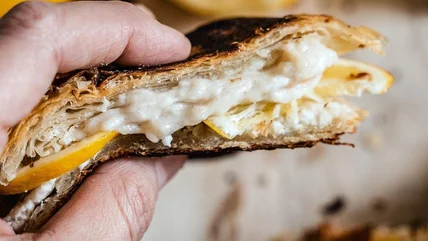
Here's a pic of those "(pan) relleno de queso" of Zacatlan, one of the most gorgeous towns of the hundred gorgeous towns in all Mexico. It is a city I love dearly. Zacatlan (in the Sierra Norte) is famous for its apples (and its apple ciders, as well as fruit liquors). This pic is from the famous Panaderia Pimentel. If I remember correctly, this bakery on 4 Ote. in Puebla (city) also has other breads like picadas, morelianas, almohadas, etc
http://www.periodicodigital.com.mx/index.php?option=com_content&task=view&id=69466&Itemid=67
Puebla, Centro Historico
2A.) The mention of Antojitos Los Portales above is not necessarily a "best of" listing-I just wanted with that mention to explain this "type" of business and the range of distinctly-Pueblan antojitos that could be found in such places (the list of Pueblan snacks is long and I have barely exhausted it on this thread: there's also jarochitas, tacos dorados, flautas etc.). Other examples of this are Antojitos Tony on (going on memory here) 3 Sur just south (?) of 5 Pte. (Also near this corner, but on 5 Pte. is Pozoleria Atlixco; the town Atlixco being famous for its distinct pozole). The Antojitos shop of my friend Juan Carlos Osorio is called Antojitos San Agustin and is on 5 Pte near the corner of (I think) 5 Sur. But he will be in front of San Agustin church tonight (the 28th) for the monthly worship at the shrine of San Judas Taddeo inside the church. Do stop by and ask him for a short history of the pelona or the chancla!!!
5.) After visiting the moloteras on 4 Pte. double back to 5 Nte. (the corner of the hand-turned arabes spit) and start walking north. Here's the start of what could potentially be a fabulous long walk on a weekend. Because starting from about 10 Pte. northwards, there is, on weekends only (but extending into lunes: for you Anonimo, this means tomorrow morning, the 29th, is your one chance!) a truly wonderful "street" market rich in "Indian" vendors of the type known as Marias-little old women selling foraged herbs/fruits or rare varieties grown in small home gardens in miniscule quantities. 5 Nte. is not totally closed off to cars, but the sidewalk vendors "take over" the street so it's virtually impossible to drive through and 5 Pte turns into a kind of pedestrian street. (Incidentally, the kid who sells nieves and chamoyadas on 3 Pte/3 Sur told me that the "municipio" has been trying for years to kill all street business and has been trying to limit all kinds of sidewalk vending to Fri, Sat, Sun and Mon only-what else is new-it's the same story everywhere in the world!)
Now the markets in Puebla city center are largely sleepy neighborhood affairs-some of them achieving a wider reputation throughout the city only for certain specialties (a specific type of bread for instance, or a specially well-regarded carnitas specialist, or the cemiteros at Venustiano Carranza or Carmen). I mentioned a couple of them on the cemitas thread: there's Parral, the Carmen, Acocota, and then the one on the southside that burned down last month etc But the big markets are on the outskirts, a large Indian market on Sun (?) and the immense Mercado Hidalgo near the bus station (CAPU). Those places dwarf this pedestrian market on 5 Nte. However, the experience of walking through this street market is incomparable! Those big markets near CAPU are convened in immense hangars, this one has as its setting some of the most spectacular streetscapes in all Mexico-an astonishing ensemble of buildings going back to the 17th and even perhaps in some cases 16th century. It's possible to imagine that it looked exactly like THIS during the time of Sor Juana Ines de la Cruz, and that the experience of walking through it is exactly the same as in her time and that there were Marias exactly like these selling the same things back then.
There are chalupas vendors of course. And old ladies specializing in tamales de charalitos (fishes packed together in dried corn husks into one long log like a tamal, the whole thing charred) and carpa al horno, both items so typical of the lake regions to the north in Puebla and Tlaxcala states. And then vendors of tortitas de elote also known elsewhere as tlaxcales (the ancient name for tortillas) or vendors of specialty breads like the ajonjoli-topped cocoles. Corn in all colors of course, piles of huauzoncle and pipichas and the quintessential papaloquelite, purple camotes, huesitos de capulin, camaron seco of all sizes, foraged mushrooms depending on the season etc It goes on and on. At 16 Pte, the street market opens up even more bec to the right is the Mercado 5 de Mayo and the street becomes even more clearly a "spillover" of the market as fishmongers, tripesellers etc begin to take over.
Again, on an absolute scale, this market/street market might not compare in sheer range of offerings with other bigger markets in Mexico (Cholula's on market day for instance). But the setting is superb and it is a walk that takes you by some really fantastic churches: La Merced on 5 Nte (and 8 Pte?), the San Juan de Dios, the famous Sta. Monica convent, the church with the cult of Jesus de las Maravillas etc
Richard
Puebla, Centro Historico
3A.) I did find some of my old notes on molotes: yes, the one I was thinking of is on 4 Pte. between 7 Nte. and 9 Nte. In fact, this is not just a nighttime stall but operate throughout the day. There are three (or four?) molote shops in a row here on the south side of 4 Pte.-all of them essentially private residences with the front room opened up and converted into a kind of shopfront, the molotera frying away in that liminal space between in and out, simple benches and tables for customers set up inside (Racheljana's comida corrida place is almost certainly similar in its setup). The one I like the best didn't have a street number but I noted that it's next to #715 and should therefore probably be #713. The three molote stands on 5 Pte. are more centrally-located and so serve as a more convenient reference point, but the moloteras of 4 Pte. are well-known throughout Puebla and are well-beloved.
The chileatole lady I was thinking about is located (by night only) on 8 Pte between 7 Nte and 5 Nte (media cuadra hacia 5 Nte) although there are several others by night all throughout the city.
From your hotel, you can get to the moloteras easily in one nice short stroll. The spectacular Sto Domingo Church is right on the corner of 5 de Mayo of course-its Capilla del Rosario is one of the pinnacles of Baroque architecture, the design scheme so extravagant and so radical it's almost modernistic. There are many tacos arabes and cemitas places and umpteenth eateries in this area-most of them meant for the large number of tourists clustered around here (but more on the subject of street-eating on 5 de Mayo later). Continue on 4 Pte and you have the shell of the old Mercado Victoria (see the parallel post on cemitas on the historical significance of Mercado Victoria) to your left. At past 3 Nte. there is a tiny plaza named Sor Juana Ines de la Cruz. Standing right on the sidewalk in front of it is an "Indian" woman (wearing large beautiful dangling earrings) who makes splendid blue corn quesadillas (huitlacoche/flor de calabaza) and gorditas de frijoles which are also known elsewhere as tlacoyos/tayoyos/tlayoyos etc. She's from San Miguel Canoa, the notorious San Miguel Canoa of the sad events recorded in the film Canoa from the mid-70s. At the corner of 5 Nte. (SE corner) is one of several tacos arabes places in Puebla called Tacos Tony (the famous one is the one on 3 Pte./3 Sur//I don't think that all of these Tacos Tonys are related//unless they're operated by diff brothers and cousins). I like to poke my head in this particular shop because it's one of the few places where you can watch (up close! bec the shop is fairly small) one of the REALLY old-style pastor spits in use. This one has three shelves to hold live charcoal (and a pan below to collect the ashes); it doesn't even have a crank for turning which means that the spit has to be hand-rotated using fingers and a knife/some other poking instrument! Such spits are becoming rarer by the day and in the US the total number could probably be counted with the fingers of one hand (I know of exactly one in Chicago: at Huentitan (on North just w of Pulaski).
Richard
Street Taco Cazo Pan...What is it Called?
Good luck! And let us know if you start a business. We'll all line up for free tacos de suadero!!!! ;0)
Street Taco Cazo Pan...What is it Called?
Good luck. And let us know if you start a business. We'll all line up for free tacos de suadero! ;0)
Puebla, Centro Historico
Quickly (I know that Anonimo is arriving tomorrow)!!! I will try to cram in as much as possible today and then fill in the blanks later (sorry, am working without my notes on these places). I am also headed for Puebla in Jan (Zacualtipan, Molango, Huejutla, Tantoyuca, Chicontepec, Papantla, Zozocolco, Coxquihui, then either west to Huachinango/Pahuatlan or back down through Altotonga to Cordoba, ending in Puebla) and will fact-check all this stuff and maybe put them together in cleaned-up form later..
3.) The most famous molote stands are on 5 Pte, just west of 16 de Sep (I hope I am getting this right: it's behind the cathedral//from the Biblioteca Palafoxiana, walk west and you will see them). There are three in a row: all built-in streetside stalls without seating: La Pequenita, la Poblanita (desde 1968 the sign says) and Acapulco. Molotes are large ovaloid (9 inches or so long//only 5 inches or so wide) tortillas (handmade corn tortillas once upon a time, now a lot of people add a measure of harina de trigo to make it more pliable) folded in half like an empanada and then deep-fried (the elongated-half-moon form would measure about 2 1/2 inches in height). The very characteristic fillings are typically "hash-like" in texture: tinga, picadillo, requeson, huitlacoche, sesos, salsicha, papa con chorizo, finely-chopped chicharron etc although these stalls also offer shrimp and pulpo. There are slight variations to the way the tortilla is folded (sometimes with one side sticking out slightly for a kind of crunchy rim or lip) but I can't really get into this now. Originally, the molote, turned upright, lower half simply wrapped in a piece of folded red/pink paper was eaten as is, without any salsa. These three are the most visible molotes stands, but molotes actually can be found throughout the city (and also in neighboring towns like Cholula) and there are specialist-fryers in virtually every market. These are also a typical nighttime streetfood in Puebla, very similar to the way tlayudas serve as nighttime food in Oaxaca (see this old post of mine on this subject):
http://chowhound.chow.com/topics/267737
Families that set up a fryer (and a couple of benches) in front of their houses at night to offer molotes and other nighttime snacks could be found by simply wandering the streets say after 9. There's one very good one on (I think) 4 Pte between 7 Nte and 9 Nte (or thereabouts//they shouldn't be hard to spot). Another very typical nighttime snack is the wonderful very distinct Pueblan chileatole (serrano, epazote, elote kernels, nixtamal masa to thicken) which I wrote about many years ago in an old thread (circa 2002) on Cemitas Puebla here in Chicago. This could also be found by wandering through this part of town at night. The three stands on 5 Pte also make pelonas (but not chanclas/guajolotes) BTW.
4.) Mueganos are a seasonal treat and are sold by ambulant peddlers from about Xmas time (now!) till start of Lent. Watch out for them!!! Also still very visible throughout the city are the sellers of meringues, who walk around with a large board (tabla) balanced on their shoulder, stacked high with gaznates, duquesas, vasitos. More on this subject later.
Sweet salty sour tamarind balls could be found throughout Mexico but I am specially fond of the Guerrerense version as well as that of Puebla, where they are typically called tarugos or tarugos enchilados. You will find old men with small backets sitting on the sidewalks selling these. He will ask if you want your tarugo 'preparado", in which case, if you say yes, he will amp up the intensity by adding lashings of yikes more chile sauce, squeezes of lime, more salt etc
Richard
Puebla, Centro Historico
1.) The church at the corner of 6 Ote/6 Nte is San Cristobal. There's a large statue of St Christopher right inside the main entrance.
2.) The name of the eatery across from the Teatro Principal is Antojitos Los Portales. The last time I was there I had a very poor taco arabe-serves me right for ordering an item that is clearly not a specialty. There are many antojitos places like this throughout the city that offer a vast range of all the typical street foods of Puebla: this one even has mole de panza (i.e. Puebla's "menudo") and pozole. But all these street foods are best enjoyed at single-item specialists: molotes at the moloteros (specially the ones that sprout up at nighttime: more on this later), cemitas at the various dedicated cemitas stands (which I started listing on the parallel thread on cemitas//more places later). Nevertheless, these antojitos shops are good places to sample three very distinct Pueblan sandwich forms that are very close to extinction. These are the chanclas, guajolotes and pelonas. Juan Carlos Osorio, who operates a peddler stand offering these sandwiches outside the San Agustin church on Sats and on the night of the 28th of each month (the day of St Judas Thaddeus: there is an impt shrine to this saint inside this church) told me that these sandwiches are fairly recent (compared to the cemita), dating only to 50 years back. Chanclas and pelonas are first of all names of breads and you can still get these breads from specialist bakers stationed near the entrance of specific markets (Acocota for instance). The chancla is a round soft roll, which is stuffed and then drenched in adobo "como si fuera una torta ahogada". The guajolote, is a chancla, but fried in lard beforehand. Pelona comes from "pan pelon" ("fraudulent bread"; historically, a bread that incorporated a lower grade of flour), is cut in half, fried and stuffed with beans (scented with avocado leaves), guacamole, and one's choice from a very specific range of possible fillings (pollo deshebrado-often hand-pulled on order, sesos, tinga, hongos etc). Nowadays, people have begun to forget the specific nuances and the specific pleasures of these unique forms and simply ask for a generic torta. A big shame. Incidentally, Juan Carlos Osorio could also be found in the Mercado del Carmen on Sundays and owns a little shop of his own on 5 Pte (I will try to find address later). A good place for a simple breakfast of coffee and mollete.
Puebla, Centro Historico
The place Racheljana recommended should be 2 or 3 blocks from your hotel. I am blanking out a little bit on the streetscape of 8 Ote. but don't recall it being particularly unsafe, at least on the Oriente side of 5 de Mayo. At the corner of 8 Ote and probably 6 Norte (i.e. just before the ring road) is the beautiful Teatro Principal. On a performance night, the plaza in front of the theater could make for some really fun people-watching. Stand with your back to the theater and look across the plaza and you will see a little eatery with a sandwich board in front advertising a huge range of typical Pueblan street food (molotes, chanclas, pelonas, guajolote etc)-the offering is uneven in quality but there are some very good things made here (the sandwiches in particular). 6 Ote of course is the celebrated ancient street specializing in sweets (Calle de las Dulcerias) it extends along 6 Ote from about 2 Norte to 6 Norte. There has been for several years now an excellent guide to the subject of these famous dulcerias, i.e. the volume called "La dulceria en Puebla" in the CONACULTA "Cocina indigena y popular" series. Rick Bayless also just published what seems to be an excellent article on this subject in the most recent issue of Saveur (Dec 08) but I have not had the time to read it so cannot tell you what it covers and what it does not. Crossing the ring road on 10 Ote., you reach the old neighborhood (much of it now demolished for the boulevard) around the beautiful San Francisco church; it was an area celebrated for the distinctly Pueblan specialty called chalupas de San Francisco (these are now impossible to find around here//but there is a fine example of it to be found at night outside the churchname escapes me at the moment-on the corner of 6 Ote and 6 Nte//much better than most of the dozen or so chalupas makers on 5 de Mayo going north on 10 Ote). From your hotel on 4 Ote, you will be very close to two famous tacos arabes places. Ranas, a board favorite (see various old posts from circa 2006/7 by "Maya") is located on 2 Pte at 5 de Mayo. Ranas' is an excellent modern interpretation of tacos arabes with brighter, more emphatic flavors (vibrant chili rub, higher levels of char etc). Not too far away is La Oriental which I enjoy just as much for its different approach, which brings out more the pure flavors of meat and fat. (Antigua Taqueria La Oriental, "desde 1933" a sign claims, has several branches throughout the city-is now a mini-chain of sorts-it claims to be the place where tacos arabes originated.) There are many other very good examples of tacos arabes both within the centro as well as outside the ring roads (try El Sultan at 31 Pte. for an outlying example) but none in Puebla itself can IMHO stand up to the two tacos arabes specialists (Tacos T and Tacos Bassam) located on 4 Ote. in Orizaba. Also on 4 Ote (I think) is a bakery specializing in the breads (pan de queso etc) of Zacatlan. More recs later if I can find some time tonight.
Richard
Street Taco Cazo Pan...What is it Called?
The correct word is probably disco, meaning a round form, discus, disc (also cf tocadiscos for long-playing (LP) records). The blogger you linked to probably heard wrong. The original conversation probably went something like this:
The blogger: que es esto?
Fish-fry man: (confused at the question and thinks: what the *&%$ is this gringo asking about?) es un disco, un disco hecho de acero ("well, it's a round thing, in stainless steel")
The blogger: Aha! Disca de acero!
Street Taco Cazo Pan...What is it Called?
I think that it might have been Iturriaga ('De tacos, tamales y tortas" Editorial Diana, 1987) who first coined the term "tacos de 'fritangas' " (he used quotation marks on the word 'fritangas'). I've certainly never heard a chilango say "let's go have some tacos de fritangas". Rather one would say "let go look for the tacos de suadero guy", although one might not necessarily end up having tacos de suadero, but this is the most characteristic of the tacos to be found and sorta carries the banner for this type of business.
Here's a bit from Iturriaga, talking about tacos de "fritangas":
(p. 54-55) Su desarrollo y tipificacion, concebidos como una rama taquera aparte, se ha dado en la ciudad de Mexico. Estos tacos son inconfundibles: hay un gran recipiente redondo y metalico, siempre lleno de manteca hirviendo, en donde nadan revuletos el suadero de res-carne que esta encima del costillar-y la longaniza de cerdo, no sin colgar el puestero y tener a la mano los tipicos machitos de carnero o intestino delgado...
There is a reason of course for the well going around instead of being located in the center: this way, the different meats fry in the same oil but can be organized and distributed all around the central "nipple' in an efficient way. Nowadays, it is more common to see another type of charola specially in the case where the street vendor has made the transition to a fixed location and has a bigger, more stable space to work in. It is the type I call a "wading pool", a flat rectangular cooking surface with a low inch-and-a-half or so rim all around, filled with with say 1/2 to 3/4 inch of oil, in which the diff meats (and even stacks of tortillas) cook away. But the round pan is still the truly iconic cooking medium for this type of taco. (Needless to say, suadero griddled on a flat-top grill, in California, or wherever, is hardly the same thing!)
To review what Iturriaga says above: the classic fillings are suadero, longaniza, machitos (coiled lengths of intestines of lamb-or goat). He also says that ubre and cuajar (rennet stomach of cow) could also be found. But one could also add to this list: chorizo and moronga. In recent years you will find a number of these vendors branching out from the classical format by practicing "product diversification" and offering other types of fillings (fillings that are oftentimes not even fried, but prepared on other heat sources)-even yikes things like carne asada. (The flattop could in this way be seen as an equalizer/or agent of dumbing-down if you wish: it separates carne asada from its true essence which comes through contact with carbon, and open fire, and suadero from its true history of contact with hot oil within a charola). In Chicago, La Chaparrita (25th and Whipple) has the classic suadero/tripa/chorizo, but also offers sesos/cabeza/lengua which are prepared separately, al vapor.
The idea of slow-cooking various types of offal in oil is of course not unique. In Ixmiquilpan, at the Monday market, there is a stall by the back entrance of the market, near where the Otomi Indians sell their home-made pulque and other goodies, where you will find a huge vat of fat bubbling away with all kinds of offal. I requested, in turn, cuajo (rennet stomach), ubre (udder//this is one of the most prized part in the carnitas culture of Michoacan//in Puebla, it is beloved as the local tacos de nana/or nenepil), lung etc, which were fished out and chopped for me. But the specific permutation of fillings, the charola etc came together in this particular way in the DF to become this unique street food form/street food institution.
Anyway, to go back to the OP's request:
what you want is "charolas de acero for tacos de suadero estilo D.F., las redondas, las que tienen un tipo de ombligo en el medio". I am sure that I have seen them here in Chicago's Maxwell Street Market, but am not sure that they could be found online.
Richard
P.S. BTW the charolas for the Pueblan chalupas de San Francisco have very shallow wells. I might have given the wrong impression above by comparing them with the charolas for frying fish.
Street Taco Cazo Pan...What is it Called?
Hey waitaminute!!!! What kind of a Spanish word is that: "disca". There's no such word, unless it's a Baja neologism or anglicism. At any rate, those are two very different kinds of frying pans. The first one (the one in pic of orig post) is the type that is used in Mexico City for the type of tacos that Iturriaga classified as tacos de fritangas. This is a very specific type of street food with its very typical chilango fillings, the most celebrated of which is the suadero. This type of taco is very hard to find outside the D.F. although there is a superb example of a purveyor of it here in Chicago. Iturriaga's text has been copied and recopied on the net (virtually never without the proper attribution) such as in this website:
http://www.blogdecocina.com.ar/blog/2006/10/03/los-verdaderos-tipos-de-tacos-mexicanos/
There is also a Mexconnect piece (in English) on types of tacos that basically cribs material from Iturriaga. You will find in both of these a basic (and incomplete) discussion of the so-called DF style tacos de fritangas.
Note that the charola (this is the proper word for the orig poster's pan) for the tacos de fritangas has the well for frying oil on the periphery. In the center of the charola is a round raised form. This "nipple" or better still, this "ombligo" is where the fried suadero, higado etc comes to rest, and for oil to drain off while waiting to fill a taco. This is a very unique form of charola and is diff from the type in kare's pic where the well for the frying oil is in the center. The charola for frying chapulas de San Francisco in Puebla is like the latter (except that in Puebla, you can often still see terracotta charolas).
Anyway, more on this tomorrow. Gotta head home. It's minus 30 here in Chicago.
Richard
Puebla: Best Cemitas in Centro?
Yes, Cholula market is pretty special. Market day is Wed if I remember correctly (with another smaller one convening on Sun). If you keep your eyes open, you can find women sitting on the ground (Marias) selling marvellous prepared food items like tortas de huauzontle or manitas de puerco capeadas, not to speak of unusual produce such as different kinds of new beans (cacamas, etc) or toasted "huesitos de capulin" for munching. But all the neighboring small cities/towns (Atlixco, Huejotzingo, Acatepec, Tonantzintla etc) have distinct histories and cultural identities and are worth visiting for the wonderful food as well.
In general, I get a sense that there is a level of dilution that takes place in the bigger cities and that smaller, more "provincial" ones are better conservers of the best food traditions. It is perhaps for this reason for instance that although you can find sushi or Thai-influenced dishes in Xalapa, better examples of say the traditional art of reposteria could be found in small neighboring towns like Perote, Cuacuazintla, Naolinco. (By the same token, I found stunning Andalucian cooking in Cadiz quite easily on a trip earlier this year, while Seville was generally disappointing.) Similarly, some of the best examples of the food most closely associated with Puebla (city) can be found elsewhere in the state, in places like Cholula etc
Richard
![header=[] body=[<img alt='' class='photo' src='http://www.chow.com/uploads/4/5/7/4754_chowhoundlogo_large.gif?20120523220005' /><br /><strong>Melanie Wong</strong>] cssbody=[user_tooltip]](http://www.chow.com/uploads/2/5/7/4752_chowhoundlogo_tiny.gif)
![header=[] body=[<img alt='' class='photo' src='http://www.chow.com/uploads/0/7/1/77170_9245_white_medium.74_large.jpg?20120523220005' /><br /><strong>Gary Soup</strong>] cssbody=[user_tooltip]](http://www.chow.com/uploads/6/6/1/77166_9245_white_medium.74_tiny.jpg)
![header=[] body=[<img alt='' class='photo' src='http://www.chow.com/uploads/4/3/0/160034_prado_pisco_sour_large.jpg?20120523220005' /><br /><strong>DiningDiva</strong>] cssbody=[user_tooltip]](http://www.chow.com/uploads/1/3/0/160031_prado_pisco_sour_tiny.jpg)
![header=[] body=[<img alt='' class='photo' src='http://www.chow.com/uploads/2/3/8/416832_curious-george_large.gif?20120523220005' /><br /><strong>Nab</strong>] cssbody=[user_tooltip]](http://www.chow.com/uploads/0/3/8/416830_curious-george_tiny.gif)
![header=[] body=[<img alt='' class='photo' src='http://www.chow.com/uploads/7/1/9/13917_tapatio_large.gif?20120523220005' /><br /><strong>kare_raisu</strong>] cssbody=[user_tooltip]](http://www.chow.com/uploads/8/1/9/13918_tapatio_tiny.gif)
![header=[] body=[<img alt='' class='photo' src='http://www.chow.com/uploads/9/4/2/309249_parrillada_large.jpg?20120523220005' /><br /><strong>Eat_Nopal</strong>] cssbody=[user_tooltip]](http://www.chow.com/uploads/6/4/2/309246_parrillada_tiny.jpg)
![header=[] body=[<img alt='' class='photo' src='http://www.chow.com/uploads/2/4/3/19342_doncuevas_large.jpg?20120523220005' /><br /><strong>Anonimo</strong>] cssbody=[user_tooltip]](http://www.chow.com/uploads/3/4/3/19343_doncuevas_tiny.jpg)
![header=[] body=[<img alt='' class='photo' src='http://www.chow.com/uploads/2/7/0/48072_endless_inside_out_circle_large.jpg?20120523220005' /><br /><strong>alkapal</strong>] cssbody=[user_tooltip]](http://www.chow.com/uploads/0/7/0/48070_endless_inside_out_circle_tiny.jpg)
![header=[] body=[<img alt='' class='photo' src='http://www.chow.com/uploads/5/5/9/181955_michael_madsen_large.jpg?20120523220005' /><br /><strong>Masa Assassin</strong>] cssbody=[user_tooltip]](http://www.chow.com/uploads/9/5/9/181959_michael_madsen_tiny.jpg)
![header=[] body=[<img alt='' class='photo' src='http://www.chow.com/uploads/6/3/3/263336_pat_nyc_large.jpg?20120523220005' /><br /><strong>patbyrd</strong>] cssbody=[user_tooltip]](http://www.chow.com/uploads/5/3/3/263335_pat_nyc_tiny.jpg)