When I finally got my hands on Plenty, the padded white tome of vegetarian recipes by Yotam Ottolenghi, I was stoked. The Israeli-born restaurateur with four eponymous, popular locales throughout London (one restaurant in Islington and three smaller takeout/cafés in Kensington, Notting Hill, and Belgravia) has some serious food cred. His first cookbook, Ottolenghi, was a bestseller. Yet I had trouble with Plenty. Flipping through it made my mouth water, but cooking from it was a different story.
The photos by Jonathan Lovekin are gorgeous. The dishes read as both comfortingly familiar and refreshingly different, like sweet potato cakes (a twist on latkes), soba noodles with eggplant and mango (interesting combo), burnt eggplant with tahini (a.k.a. baba ghanoush with pomegranate molasses and seeds), and more. Some vegetarians complain that Ottolenghi, a full-fledged carnivore, sometimes recommends serving his meatless dishes with lamb chops. But his prowess with vegetables turned him into a successful columnist for London's Guardian newspaper. Plenty is a compilation of many of the recipes from his New Vegetarian column.
Things seemed promising until I started cooking. We first tested the roasted butternut squash with sweet spices, lime, and green chile. Flop number one! The tahini yogurt, which tasted mostly of tahini, didn't work with the squash and the abrasive lime slices. The recipe made so much sauce that we could have drizzled it over 20 times the amount of squash called for.
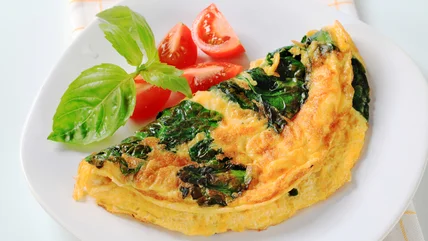
A bit defeated, we returned to the book for another try. This time we decided on crêpe-thin chard and saffron omelets, folded and stuffed with crème fraîche, saffron potatoes, and wilted Swiss chard.
I followed the recipe by simmering small cubed (1-centimeter) potatoes in saffron water for 14 to 19 minutes. As I suspected, by the time the potatoes hit 14 minutes, they were mush. I continued to follow the instructions, draining the chard and potatoes from the saffron water. Wait! That saffron cost me at least $3. And we're going to just pour it down the drain? The potatoes weren't nearly as dark yellow as the ones in the photo; they were fibrous and light yellow, with no traces of saffron flavor.
The omelets cooked up beautifully; you can see the recipe here. They reminded me of the rolled eggs my grandfather used to make. But when folded with the crème fraîche, loose pieces of potato, and wilted chard, the omelets tore. The bland-tasting potatoes and chard fell out of the triangular packages as we ate them. To help bind the dish together and add flavor, it needed a sauce—a poached egg in the center would have helped. Flop number two!
Our last and final attempt was the black pepper tofu. We chose it because it was a main dish and we had never seen anything like it. But once I got started, the recipe seemed flawed. It called for "8 fresh red chilies (fairly mild ones), thinly sliced." Is that with or without seeds? What kind of chiles, and how big? There were more problems: Should the "crushed" garlic be smashed, pressed, or minced? Should the ginger be chopped finely, roughly, or minced? I forged on, deep-frying the tofu, then tossing it into the sauce (made from a huge amount of butter, shallots, chiles, soy sauce, sugar, and 5 tablespoons of coarsely crushed black peppercorns). And why use corn flour with all those Asian flavors? Flop number three. Reports about Plenty from Chowhound's Home Cooking board also singled out this recipe as disappointing. I chuckled when a colleague came to taste it and said, "Yay! Tofu—something healthy." The dish was decidedly unhealthy (too greasy), and too spicy. If I were to make it again, I would add less butter to the sauce or use none at all, I would pan-fry the tofu instead of deep-fry, and I would use less black pepper.
And that is exactly what you should do with this book: Use it for inspiration; don't follow it blindly. Plenty is a great addition to the scarce selection of sexy and creative vegetarian cookbooks. But please, Yotam, next time hire a good recipe tester. We're a dime a dozen.


I've been very happy with this book. Several dishes in it have been extremely flavourful, and none of them were particularly time-consuming. And I'm a meat guy...
I've made a dozen recipes from the book, and they've mostly been fantastic, though I've had a couple of flops. The ones highlighted in this article are actually ones I remember skipping over because they looked too complicated.
I made three recipes out of it last night--spicy carrots, winter slaw and sweet potato cakes--and despite having to substitute a few ingredients I did not have on hand, every single one was AMAZING. I have no idea what everyone is talking about here. In fact, I just ate the leftovers for lunch. Best vegetarian recipes I have seen in an eon.
Made eggplant with buttermilk sauce last night ... same issue as below with truro ... finally set oven at 400 and that did the trick. Everything else worked well, though if I make it again, and I will, I'll season the eggplant a little more heavily before baking. Otherwise, it's beautiful on the plate - a great appetizer. Served it with little toasts.
I made the Puy Lentil Galette last night and the thickness of the puff pastry was way to thick (1-1/4") When baked as instructed, it was raw inside. I just found Yotam Ottolenghi's recipe (under his name) in The Guardian. That recipe uses metric measurements and says the pastry should be 3mm (millimeters) thick - which is a little less the 1/8 inch! I think the editors of this cookbook screwed...+READ
I made the Puy Lentil Galette last night and the thickness of the puff pastry was way to thick (1-1/4") When baked as instructed, it was raw inside. I just found Yotam Ottolenghi's recipe (under his name) in The Guardian. That recipe uses metric measurements and says the pastry should be 3mm (millimeters) thick - which is a little less the 1/8 inch! I think the editors of this cookbook screwed up. They must have thought it was 3 cm (centimeters) which would be 1 1/4 inches-COLLAPSE
I also made the Roasted eggplant with Buttermilk Sauce but follow it to the letter, 200 F. for 40 minutes, and as to be expected, it did not work... I thought that there may be a problem with the translation between Celsius vs Fahrenheit, but this was my first time to cook eggplant... Looking forward to trying again tonight!
I recently made the Roasted Eggplant with buttermilk sauce from the Plenty cookbook and there were deff some errors in the recipe - for example, it says to "roast" the eggplant for 40 min at 200 degrees. lol. Because I know what roasting is, I knew that could not be right and I changed it accordingly (400 for 40 min worked well) but for someone who is an inexperienced cook, that would have been...+READ
I recently made the Roasted Eggplant with buttermilk sauce from the Plenty cookbook and there were deff some errors in the recipe - for example, it says to "roast" the eggplant for 40 min at 200 degrees. lol. Because I know what roasting is, I knew that could not be right and I changed it accordingly (400 for 40 min worked well) but for someone who is an inexperienced cook, that would have been an incredibly frustrating typo.-COLLAPSE
I tend to agree with this review, having tried several of the recipes and following them as if they are the Bible... Makes me wonder - are there some typos in the book..? eg 5 tablespoons of black pepper with the tofu.. 3 tablespoons mustard in the broccoli and gorgonzola pie.. Can this be right? Is someone getting tablespoons and teaspoons mixed up?
I too have had amazing results from this book. The Very full tart is spectacular, with and without the crust, and changes in the type of cheese (try a smoked cheese) and veggies make it very adaptable. I love this book and have given it to everyone I know who loves food, vegetarian or not.
Having trouble taking the review seriously after the non-sensical second sentence... misuse of both eponymous and locale.
http://topics.blogs.nytimes.com/2010/09/14/words-we-love-too-much-5/
Hmmm..Jill santopietro is a pretty widely respected and experienced cook. I think she isn't the type of person looking for a "set it and forget it" type cookbook, and she is very diligent in testing the recipes she has created. But I suppose that she is trying to imagine you're a complete novice, trying to follow ottolenghi's recipes to the letter. Items like what she mentioned are what turn...+READ
Hmmm..Jill santopietro is a pretty widely respected and experienced cook. I think she isn't the type of person looking for a "set it and forget it" type cookbook, and she is very diligent in testing the recipes she has created. But I suppose that she is trying to imagine you're a complete novice, trying to follow ottolenghi's recipes to the letter. Items like what she mentioned are what turn people off of cooking and towards take-out.
Also, maybe she thought the recipe called for too much cornstarch? From ChiChi Wang's article on the function of cornstarch in asian cooking (http://www.seriouseats.com/recipes/2009/09/cornstarch-stir-frying-asian-food-slurry-woks-hunan-lamb-recipe.html) at SeriousEats: "You can always add a bit more if the liquid doesn't thicken properly, but you can't easily repair the effects of a gluey, overly-thickened sauce."
I for one appreciate her article...it's nice to know this before you expend the effort and time. This is why blogs have become so popular - because you get to know what the home (and even expert/professional!) cooks experience and you can avoid having the same problems.-COLLAPSE
While I'm willing to believe that the recipes could be at fault, some of the author of this article's complaints seem a bit weird!
I wouldn't expect a recipe to specify the kind of chilli required: I know what kind I'd buy, because I know what my heat tolerance is. Recipe writers aren't supposed to assume their readers to be idiots, surely.
Would you complain if a recipe didn't specify exactly...+READ
While I'm willing to believe that the recipes could be at fault, some of the author of this article's complaints seem a bit weird!
I wouldn't expect a recipe to specify the kind of chilli required: I know what kind I'd buy, because I know what my heat tolerance is. Recipe writers aren't supposed to assume their readers to be idiots, surely.
Would you complain if a recipe didn't specify exactly which variety of tomato, or aubergine, or whatever, to use? Normally a little personal agency will do the trick.
Similarly with the garlic issue. Perhaps it's a UK vs US English thing, but in the UK 'crushed' garlic means only one thing. You crush the garlic in a gadget that most people own that I can only call a garlic crusher. There's a tautologous sentence if ever there was, but that's why it's so obvious to me what you're meant to do with the garlic! You know, you put in the garlic, you press down on the handle and it presses it out through little holes so you have - crushed garlic! Not smashed or pressed or minced.... crushed.
'Why use cornflour with all these Asian flavours?' - Cornflour is regularly used in Asian-style cooking to thicken sauces etc. Seems to make perfect sense to me. Again, is the problem perhaps a transatlantic thing? What's called "cornflour" in the UK is called "cornstarch" in the US.
Finally, about the saffron potatoes: did the writer use floury or waxy potatoes? It sounds like perhaps they used a floury kind as they broke down in the water. If, as the author says, they anticipated this problem, why not just use a little common sense and buy a variety of potato that won't break down when simmered?!-COLLAPSE
Having blindly followed a number of Ottolenghi recipes from this book and the previous one, he is one of the only cookbook authors whose food I cook as written, with no additional spices and herbs added (a rarity for me, as a lover of big flavors who frequently needs to add more of what is called for). His food is truly terrific and I'm not sure why the reviewer got the results she did, but I...+READ
Having blindly followed a number of Ottolenghi recipes from this book and the previous one, he is one of the only cookbook authors whose food I cook as written, with no additional spices and herbs added (a rarity for me, as a lover of big flavors who frequently needs to add more of what is called for). His food is truly terrific and I'm not sure why the reviewer got the results she did, but I wonder if she may not have compensated for differences between English ingredients and American ones (the book has not been issued in the U.S., therefore it is written for an English audience and their produce, commonly available ingredients, etc.).-COLLAPSE
Interesting comments about the Black Pepper Tofu. I looked up the recipe in The Guardian online and it looks really straightforward. In the article accompanying the recipe, Ottolenghi warns that the recipe is very hot, despite him reducing the amount of chillies compared to the original.
I can't understand the columnist's confusion about crushed garlic; surely crushed garlic is just crushed...+READ
Interesting comments about the Black Pepper Tofu. I looked up the recipe in The Guardian online and it looks really straightforward. In the article accompanying the recipe, Ottolenghi warns that the recipe is very hot, despite him reducing the amount of chillies compared to the original.
I can't understand the columnist's confusion about crushed garlic; surely crushed garlic is just crushed garlic, i.e. garlic you crush with a garlic crusher!
I found the comment, "And why use corn flour with all those Asian flavors?" unusual because cornflour is a staple in Asian cooking for dredging and thickening.
Also, pan-frying the tofu instead of deep-frying it is tantamount to blasphemy! Deep-fried tofu is a basic of Malaysian and Indonesian cooking and is quite, quite delicious. Pan-frying would change the texture of the tofu and hence the entire dish completely. To me, this recipe sounds utterly delicious and very similar to many deep-fried tofu dishes that I love. I also can't understand why the columnist thinks the dish is unhealthy - it serves 4 and doesn't contain buckets of cheese and eggs like many European vegetarian dishes.
I disagree with the columnist's recommendation to .."Use it for inspiration; don't follow it blindly.". Why buy a favoured chef's cookbook if you aren't going to follow the recipes? I say follow the recipe blindly and if you don't like it, don't make it again.-COLLAPSE
I must live in a parallel universe! I have cooked a number of recipes from Plenty and found ALL of them terrific. The Very Full Tart (don't have the book with my right now so exact name is prob wrong)which is a tart filled with all kinds of veg and cheese was fabulous.
I also have made the ratatouille several times and find it to be the best I've ever had. I was quite sick of ratat. and hadn't...+READ
I must live in a parallel universe! I have cooked a number of recipes from Plenty and found ALL of them terrific. The Very Full Tart (don't have the book with my right now so exact name is prob wrong)which is a tart filled with all kinds of veg and cheese was fabulous.
I also have made the ratatouille several times and find it to be the best I've ever had. I was quite sick of ratat. and hadn't made it in years. My husband requests it frequently.
The green pancakes with lime butter were also quite good.
The best so far, however,has been the puy lentil galettes. A fabulous mixture of lentils, yogurt, spices served in puff pastry shells. This is one of the best-received recipes I've ever made. I've cooked it for a couple of dinner parties and have gotten raves and requests for the recipes.
I really don't see how the reviewer found this book lacking. I admit I haven't made the two recipes she cites, but the ones I've tried have all been great.
Yotam Ottolenghi is a terrific addition to the world of food! Long may he trive..or even thrive.-COLLAPSE
Thanks Felila, for bringing a publishing company employee's take on this. I wondered whether a celebrity chef cookbook is ever tested? Now I know that it is not an automatic, but a choice.
It looks really delicious. This the nice thing reading your blog your post really great.
I find it strange that the reviewer referred to a post on the Home Cooking board that supported your opinion, but failed to mention the many positive reviews on the same thread. I've made a few recipes from this book and they've all be great.
"And why use corn flour with all those Asian flavors?"
Corn flour is the British term for what in the US is called cornstarch, and is to my knowledge, a standard ingredient in Chinese cooking (slurries, marinades, and so on), and is also used in this way (dusting tofu before deep frying). So I'm not sure I understand the objection.
While I did indeed report on Chowhound that I wasn't thrilled with my attempt at cooking the Black Pepper Tofu from Plenty, I also reported that I cut the recipe in half and made a number of substitutions and modifications. Since I did not follow the recipe faithfully, it’s hard to say whether the problem was with the recipe as written or with my modifications. Also, in that same post, I alluded...+READ
While I did indeed report on Chowhound that I wasn't thrilled with my attempt at cooking the Black Pepper Tofu from Plenty, I also reported that I cut the recipe in half and made a number of substitutions and modifications. Since I did not follow the recipe faithfully, it’s hard to say whether the problem was with the recipe as written or with my modifications. Also, in that same post, I alluded to the fact that I am more accustomed to cooking using standard American measures and that it’s possible I made an error when converting from metric. My husband, who tolerates but does not love tofu, really enjoyed the dish, modifications and all.
~TDQ-COLLAPSE
I've never been one to blindly follow a recipe so this doesn't really bother me. I've also been cooking long enough to know if I want the seeds from a pepper in my dish or how I want to prepare the garlic, so those details don't really bother me either. I can see how this would be annoying or confusing to a beginner, but I don't think that Plenty is a beginer's cookbook. The potatos were bland?...+READ
I've never been one to blindly follow a recipe so this doesn't really bother me. I've also been cooking long enough to know if I want the seeds from a pepper in my dish or how I want to prepare the garlic, so those details don't really bother me either. I can see how this would be annoying or confusing to a beginner, but I don't think that Plenty is a beginer's cookbook. The potatos were bland? Did you taste them after you seasoned? I have this book and really enjoy it. Everything I've cooked from it so far has been super tasty, but then, I pretty much always tweak recipes to be more my style.-COLLAPSE
Our kosher cooking group chose Ottolenghi's recipes as the theme of our Sept 4 dinner. Each person was assigned a recipe which appeared on his website. We had alot of fun that night, marveled at some of the dishes, but heard alot of complaints, too.
We're some pretty good cooks, and admitted foodies. I'll just say that there was alot of doctoring of certain recipes. Salt seemed to be lacking,...+READ
Our kosher cooking group chose Ottolenghi's recipes as the theme of our Sept 4 dinner. Each person was assigned a recipe which appeared on his website. We had alot of fun that night, marveled at some of the dishes, but heard alot of complaints, too.
We're some pretty good cooks, and admitted foodies. I'll just say that there was alot of doctoring of certain recipes. Salt seemed to be lacking, other dishes were really bland. We did perceive a theme of repeated ingredients...thyme, lemon, cinnamon, and caramel.
It's safe to say that our group proofed some of the recipes that night, and it wasn't pretty.-COLLAPSE
If the recipes direct you to make huge quantities of sauce, that's probably because the cook supplied the recipe used to make sauce for the restaurant, and the cookbook editor didn't downsize the ingredients for the home kitchen. I almost missed this on the first cookbook I edited. Fortunately, I asked a friend to test one of the recipes and she reported that she ended up with a quart of leftover...+READ
If the recipes direct you to make huge quantities of sauce, that's probably because the cook supplied the recipe used to make sauce for the restaurant, and the cookbook editor didn't downsize the ingredients for the home kitchen. I almost missed this on the first cookbook I edited. Fortunately, I asked a friend to test one of the recipes and she reported that she ended up with a quart of leftover sauce.
If the recipes don't work, it's probably because the publisher hired a not-so-great editor and didn't pay for recipe testing. The publisher-for-whom-I-will-no-longer-work also cheaped out that way.-COLLAPSE