Dreading a Sustainability Backlash

We talk a lot at CHOW.com about how San Francisco is obsessed with food and dining to an extreme we never thought possible. Seriously, you would think there is nothing else to do in this town. No bands to go hear, no theater to go see, no trails to go mountain bike on, no sex to be had. All anybody wants to do is Try the New Bar Agricole! Get Into Flour + Water Restaurant! Wait in Line for Hours For the New Pop-Up Ramen Place! As a reporter at the now-defunct Internet business weekly the Industry Standard, I saw this same hysteria during the dot-com boom. And I saw it die and people move on. What frightens me is not that this will one day happen to the food fetish movement, but that when it happens, we will lose some of the exciting gains that have come about as a result of local/sustainable sourcing becoming "cool."

We're rediscovering lost varieties of corn and cucumbers our ancestors ate, before they were almost driven out of existence through genetic modification. People are getting into making things they formerly just picked up at stores, whether it's growing their own herbs or canning and pickling. Studies have shown that humans attain greater happiness through experiences than purchases. A growing chunk of the American public is beginning to tune in to the fact that our country's meat production system is cruel, environmentally harmful, and physically dangerous. There are so many more good things, I could go on and on.

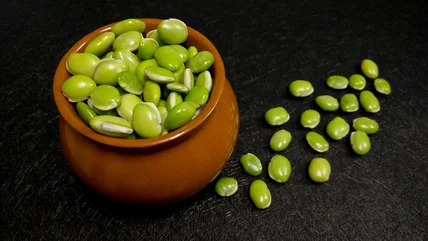
And yet. Yesterday, I was interviewing a prominent young chef in the city who shall remain nameless, because I fear his comments here are a little taken out of context. He said that he "wasn't into the local/sustainable thing," because it "wasn't efficient." If he had said, "I don't believe women should vote because they're too emotional" I do not think I would have been more surprised, considering how ultra un-P.C. this stance is these days. He later went on to dismiss a local trendy ramen maker for putting Blue Lake beans in his ramen, and other types of designer produce, rather than working on the fundamentals of his broth. "I think he's missing the point," the young chef said.

It was clear to me that this chef objected, ultimately, to the tiresome trendiness of the local/sustainable thing. His contrarian, intellectual-satirical streak had a problem with the naive idealization of a fantasy agrarian lifestyle. It reminded me of that great scene in Annie Hall when Woody Allen's Alvy character, despite his better judgment, goes on a visit to California, where he's predictably alienated by the mantra-spouting, sprout eating, fashion hippies he encounters there, and hightails back to NY in his tweeds.

So how do we make sure that the baby isn't thrown out with the bathwater, when consumers and chefs ultimately tire of the preciousness of the homespun farm aesthetic, and turn to the next cool thing?

POST A COMMENT |11 Comments

COMMENT

  • Food trends come and go but the concept of raising awareness of a better way of living is completely different. The local, organic movement is raising the public's awareness. It's instilling ethics into a population that didn't consider the consequences before.

    Someone who has eaten chicken all their life is suddenly starting to question whether that chicken was pumped with antibiotics and...+READ

    Food trends come and go but the concept of raising awareness of a better way of living is completely different. The local, organic movement is raising the public's awareness. It's instilling ethics into a population that didn't consider the consequences before.

    Someone who has eaten chicken all their life is suddenly starting to question whether that chicken was pumped with antibiotics and figures out that their next illness won't be cured by the antibiotics their doctor perscribed.

    Someone who is a vegetarian is made aware that the tofu they are eating is made of genetically modified soy. That GM soy growing in fields with weeds that no longer respond to Roundup. That GM soy is grown in previously rainforested parts of Brazil. It takes awareness to stop eating it and ask for farmers to grow soy beans locally, on small scale, in a sustainable fashion. It takes consumer demand for someone to come and start making tofu locally.

    This is a movement, an ethical revolution. It won't fade unless we begin ignoring all that we've learned these past few years and go back to our mindless drive-thru burger consumption.

    The young chef's blind cynicism is unfortunate. He appears to not want to jump on ANY food trend bandwagons. It's an honorable stance but one that is out of sheer ignorance. He has decided not to put any "brain time" into considering what it means to be using organic, local produce. Someone should send him some information.-COLLAPSE

  • The problem with sustainability is that the human race, as it stands, is not. There are far too many of us, consuming far too much per capita, to feed in any sort of rational way. Unfortunately, those in a position to influence this, the wealthy and powerful, are (by what is no doubt coincidence) the only ones who benefit from a bloated, consumption mad populace.

  • Local/sustainable means much more than this chef realizes, to small farmers and local and organic producers. It means that we can grow what works in our own microclimate and with our own soils, and in a manner which does not require huge inputs of fertilizers and herbicides and pesticides. It is not just the naive idealization of a fantasy agrarian lifestyle. Rather is protects our food supply...+READ

    Local/sustainable means much more than this chef realizes, to small farmers and local and organic producers. It means that we can grow what works in our own microclimate and with our own soils, and in a manner which does not require huge inputs of fertilizers and herbicides and pesticides. It is not just the naive idealization of a fantasy agrarian lifestyle. Rather is protects our food supply from being taken over by global corporations producing only commodities.-COLLAPSE

  • "We're rediscovering lost varieties of corn and cucumbers our ancestors ate, before they were almost driven out of existence through genetic modification."

    There are no GMO cucumbers approved for use anywhere in the world. GMO corn goes back only to 1996 (the days of some of our ancestors, I suppose) and is used for industrial corn, not what we grill and put on the table--it is hardly in danger...+READ

    "We're rediscovering lost varieties of corn and cucumbers our ancestors ate, before they were almost driven out of existence through genetic modification."

    There are no GMO cucumbers approved for use anywhere in the world. GMO corn goes back only to 1996 (the days of some of our ancestors, I suppose) and is used for industrial corn, not what we grill and put on the table--it is hardly in danger of driving these varieties out of existence. So what the hell are you talking about? This post is a perfect example as to why a backlash is needed: most of the people involved in this trend are completely misinformed about food.-COLLAPSE

  • I believe it will last if and only if parents actively involve young children to create childhood experiences that consist of conscious eating/farming etc.
    This is based on the above mentioned research that humans are more interested in the experience than the purchase. What is a fad for us can be the norm for future generations

  • it wont last not because of coolness lost or any reason we choose the govt is working to end social trade of food. it is also on its way to control the food system through agri giants. you and i will not legally be able to grow, buy, sell, trade locally/regionally small produced foods. as people concerned about where our food comes from and how it tastes please check the following link:...+READ

    it wont last not because of coolness lost or any reason we choose the govt is working to end social trade of food. it is also on its way to control the food system through agri giants. you and i will not legally be able to grow, buy, sell, trade locally/regionally small produced foods. as people concerned about where our food comes from and how it tastes please check the following link: http://foodfreedom.wordpress.com/2010/04/24/s-510-is-hissing-in-the-grass/#more-1828
    please express your concerns to friends/family etc about bill S510-COLLAPSE

  • Um, dare I say it? Home or small scale farming isn't an aesthetic, no matter what trend minded consumers and chefs may look for in the market. The aesthetic you speak of is mostly a marketing tool aimed at the uninformed. Perhaps the hipsters, be they chef or consumer, will move on. Small scale produce will remain in demand, whether or not it's "cool." If it's fresher, it tastes better, cooks...+READ

    Um, dare I say it? Home or small scale farming isn't an aesthetic, no matter what trend minded consumers and chefs may look for in the market. The aesthetic you speak of is mostly a marketing tool aimed at the uninformed. Perhaps the hipsters, be they chef or consumer, will move on. Small scale produce will remain in demand, whether or not it's "cool." If it's fresher, it tastes better, cooks better, presents better on the plate;No matter how it's marketed.-COLLAPSE

  • One contrarian chef does not a backlash make. That said, he's *obviously* not the only one who's not committed to local/sustainable foods for economic/practical reasons. Yet most signs indicate that the movement (which isn't quite the same thing as a trend) is only growing, don't they? That's how it seems to me in any case.

  • I also fear that once the locavore trend is over, Velveeta and Dinty Moore (or whatever) will be the next hot food trend. But like all trends (remember the environmentalism of the late 80s?), some lasting changes will come out of it. Local organic gardens/farms have been established and are likely to keep producing. Most restaurants will maintain relationships with local food producers. A few of...+READ

    I also fear that once the locavore trend is over, Velveeta and Dinty Moore (or whatever) will be the next hot food trend. But like all trends (remember the environmentalism of the late 80s?), some lasting changes will come out of it. Local organic gardens/farms have been established and are likely to keep producing. Most restaurants will maintain relationships with local food producers. A few of the best cupcake shops will remain open. Well, that's a different trend, but you get the point. In short, we're likely to take a step back, but sustainable food has taken a few steps forward, and for that we should be happy.

    Plus eventually all this *will* trickle down to the mainstream. My local chain supermarket is selling heirloom tomatoes--albeit not organic or local.-COLLAPSE

  • One question that crosses my mind is whether or not sustainability (and its cousin locavore-ism) is in fact a movement or a trend among a tiny segment of the population. And by extension whether the covering-up of farmland by development makes it impossible to feed urban populations with locally grown food. As in are there any orchards left in Cupertino and environs?

    On the issue of varietal...+READ

    One question that crosses my mind is whether or not sustainability (and its cousin locavore-ism) is in fact a movement or a trend among a tiny segment of the population. And by extension whether the covering-up of farmland by development makes it impossible to feed urban populations with locally grown food. As in are there any orchards left in Cupertino and environs?

    On the issue of varietal veggies, perhaps Blue Lake beans are exotic to the ramen chef. Who knows his background. My personal fave pet peeve is "heirloom" tomatoes. Wouldn't it be a hoot to grill the server who touts those as to which of the hundreds of very different varieties is being served. And why it was selected.-COLLAPSE

  • Did you actually read the Blue Lake bean article you linked? From the first paragraph: "Although it has rather humble origins as a canning bean,..." Thus, although it may be trendy, it's far from "designer produce." What's perhaps new is applying varietal labels to something that in the past was just a "green bean."