Fungus Amongus

If you’ve eaten a truffle in the United States, it probably wasn’t grown here. It’s not that we don’t have any—there are nearly a thousand wild-truffle varieties in the United States. But only a few are delicious.

Oregon truffles (black, white, and the rare brown) are the most sought-after wild, uncultivated ones. In spite of their name, they grow from northern California to Washington on the roots of Douglas fir trees. Charles Lefevre, the owner of Oregon-based New World Truffieres and president of the North American Truffling Society, says Oregon truffles can be every bit as good as French and Italian varieties: He says he can still vividly recall an omelet laced with Oregon truffles he ate ten years ago.

A truffle is essentially a mushroom that grows underground on the roots of trees. Because it grows beneath the ground, it can’t release its spores like other mushrooms and instead relies on animals to dig it up, eat it, and disperse its spores. Unlike fruit, which displays bright colors to signify that it’s ready to eat, the truffle depends on its aroma to attract the agents of its propagation—most traditionally, pigs. Dogs can be trained to hunt truffles with a buried film canister stuffed with a truffle oil–soaked cotton ball.

Truffle cultivation is not new. Because urbanization, acid rain, draught, and other factors have been shrinking wild supplies of the beloved Perigord truffle, beginning in the 1970s the French government set about figuring out how to cultivate them through inoculating trees with spores. Now as much as 80 percent of French-grown Perigord truffles are cultivated.

A pound of top-grade black truffles can sell for more than $1,800. The French saw a business opportunity and started selling their truffle-cultivation technology in the 1970s, spreading the Perigord truffle to China, Croatia, Spain, Australia, New Zealand, and the United States. In North Carolina, Franklin Garland opened Garland Gourmet Mushrooms and Truffles in 1993, growing truffles and selling inoculated trees. Now he’s trying to get North Carolina tobacco farmers to switch from growing the cancer-causing leaf to cultivating high-dollar fungi.

One of Garland’s early customers was truffle farmer Tom Michaels, who realized that the red clay of his new Tennessee home was very similar to the soil of northern France. Three years ago he planted 2,500 hazelnut and oak trees, which he inoculated with black truffle spores (it takes five to ten years for a truffle-inoculated tree to start producing). If Michaels’ spores bear fruit, he’ll be on the vanguard of American truffle production.

Some chefs in the Pacific Northwest use Oregon truffles when they can find them. But few pro cooks across the country have had the opportunity to use American-grown truffles. Because of this, chefs are taking a wait-and-see approach.

“If someone can give me one and it compares to a (French) Perigord truffle, I’ll take a look at it,” says David Kinch, chef at Manresa, a restaurant in Los Gatos, California. “The proof will be on the plate.”

Specifics

How to Use Them

When using truffles in the kitchen, don’t prepare anything too complicated, as you want the truffle’s flavor to come through. A high-quality truffle will be so pungent that its aroma will permeate anything it is stored with. To see what we mean, store the truffle in a container of rice or eggs, cover it tightly, and refrigerate it until you’re ready to use it. The rice or eggs will take on the scent and will yield you heavenly truffle-scented risottos and omelets (and you can use the truffle itself in another dish).

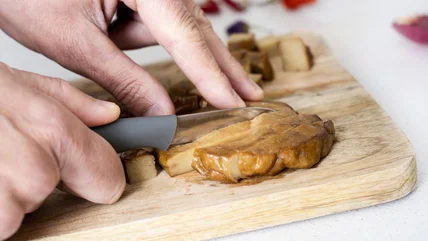
As a general rule, use the more robust black truffles (raw or cooked) to top omelets or pasta, or in this Truffle-Roasted Chicken. Reserve the more delicate white truffles for shaving raw over dishes as a last-minute garnish. While a truffle slicer certainly helps in making paper-thin slices, you can also just slice the truffle finely with a paring knife.

Oregon Truffle

Where grown: From the Cascades to the Pacific coast, and between far northern California and southern British Columbia.

Flavor: White—oniony, musky, and earthy, with a kick. Black—more savory than white, chocolaty aroma, pungent. Brown—much less intense than white or black, with a garlicky aroma.

Source: White and black—Oregon Wild Edibles. Brown—not available commercially.

Cost per pound: About $150 for white, $300 for black.

Season: Mid-December through February.

Italian White (Piedmont) Truffle

Where grown: Northern and central Italy, and southern Yugoslavia.

Flavor: Strong pepper-garlic aroma; pungent, earthy, spicy taste that’s stronger than any other variety’s.

Source: Dean and DeLuca.

Cost per pound: $2,000 to $4,000 (or $200 to $300 per ounce).

Season: September through December.

Black Perigord Truffle

Where grown: France, Spain, Croatia, China, Australia, New Zealand.

Flavor: Strongly earthy with slight fruity aromas.

Source: Vervacious.

Cost per pound: $800 to $1,200.

Season: Late November through February.

Burgundy (Summer) Truffle

Where grown: France, Italy, Spain, Sweden, New Zealand.

Flavor: Similar to Perigord’s but less intense.

Source: D’Artagnan.

Cost per pound: $400 to $500.

Season: May through October.

POST A COMMENT |16 Comments

COMMENT

  • Lisa~
    I don't know if it's kosher to post contact info for business hereon, but oregonwildedibles.com

  • I want to get in touch with mycophile so I can try some of their truffles. They know their stuff and I want to do some business!

    Lisa
    san jose ca

  • I am camera-challenged, so I have no truffle pics I have taken myself. It might have been the same one I saw just a few days ago, posted by a blogger, from the 2006 OTF, cut in half, showing both halves. If so, it WAS a nicely-marbled specimen, and would be a good link to suggest to folks for a visual reference of what good marbling should look like in a White.

  • Yes, the visible undulating gleba/asci striations. Characteristic of interiors of both famous classic truffle types from Europe (Tuber melanosporum and T. magnatum). But missing, or at least invisible, in my experience of many samples of the "Summer truffles" (T. aestivum) that invaded the US in recent years, sometimes deceptively labeled "black truffles." (The "summer truffle" is recent in the...+READ

    Yes, the visible undulating gleba/asci striations. Characteristic of interiors of both famous classic truffle types from Europe (Tuber melanosporum and T. magnatum). But missing, or at least invisible, in my experience of many samples of the "Summer truffles" (T. aestivum) that invaded the US in recent years, sometimes deceptively labeled "black truffles." (The "summer truffle" is recent in the US market and is all but unmentioned in classic food literature mentioning truffles. Of which I have a lot, I assure you.)

    FYI, best example of T. oregonense gleba/asci marbling that I saw in online photography came from you, mycophile, or anyway it was attributed to your firm, in photos I found in online search. (My memory of using these Oregon white truffles in person was that the marbling was present but faint.)-COLLAPSE

  • eatzalot--

    agreed. appreciated. anticipated.

    "Marbling", in truffles, is the visual result of the contrast between the interior of the "gleba" (the pockets of spores), and the "sterile tissue" surrounding the gleba. The sterile tissue looks like a web, and/or "veins", and is tissue that cannot produce spores. I am not sure if ALL species of truffles do so, but I do know that, in the more...+READ

    eatzalot--

    agreed. appreciated. anticipated.

    "Marbling", in truffles, is the visual result of the contrast between the interior of the "gleba" (the pockets of spores), and the "sterile tissue" surrounding the gleba. The sterile tissue looks like a web, and/or "veins", and is tissue that cannot produce spores. I am not sure if ALL species of truffles do so, but I do know that, in the more culinarily interesting species, when their spores mature, they produce substances (such as "tannins") that are dark (in "Black" truffles, they might be blackish, in "White" truffles they might be brownish, etc. There are other colors.)

    The greater the percentage of mature spores in a given gleba, the darker it will appear, providing a greater contrast with the sterile tissue, resulting in a more "marbled" appearance to our sight. Thus, the degree of maturity of a given truffle can be judged by its relative degree of interior marbling. This is a KEY factor in selecting my indigenous truffles of choice for purchase, or at least for continuing to process them towards sale. Consumers should outright reject, and loudly so, any specimens of such species of truffles that cannot be seen to have sufficient marbling.

    However, since my experience with a plethora of species of truffles is, so far, limited, I cannot be sure that ALL species can be judged for maturity this way. There are MANY species of hypogeous fungi in Oregon, alone, for instance, many of which are refered to as "truffles", which, when fully mature, appear to be all one color inside (thus no "marbling"). Of course, they are not considered culinarily special, either. I am unclear as to how much of this is directly extrapolable to the European "summer" truffles, or Chinese truffles, or other would-be-imposters of Tuber melanosporum, but it would not surprise me if it all was.

    BTW, I am suspicious of online pics of truffle marbling. I have seen pics of truffles that were clearly color-enhanced. I have seen some pics of truffles I offered photographers as examples of IMMATURE truffles, that came out looking as if they were marbled. I have seen pics of nicely mature truffles of mine that came out looking almost solid black, or even "ruddy", because the photo editor wanted to make some other part of the picture look better.-COLLAPSE

  • Thanks mycophile for information on different qualities of Oregon Whites. (Your comments here, if I may say so, are more thoughtful and less eccentric than some I have read online from other passionate Oregon-White promoters.)

    In online pictures of them, I note a "marbled" interior as with better-known truffle species. (But not in the cheap black species now being passed off in the US to...+READ

    Thanks mycophile for information on different qualities of Oregon Whites. (Your comments here, if I may say so, are more thoughtful and less eccentric than some I have read online from other passionate Oregon-White promoters.)

    In online pictures of them, I note a "marbled" interior as with better-known truffle species. (But not in the cheap black species now being passed off in the US to inexperienced customers in place of classic black T. melanosporum, the complaint upthread in the linked posting.) But we've belabored Oregon Whites after this Feature story, which is wider in scope, so if I follow up further it will be offline.


    "The renewal of a taste for truffles is fairly recent. ... We owe [their wider availability] to merchants of fine edibles, [who have them] shipped to Paris by messenger and fast express." -- Brillat-Savarin, 1826 (Tr. MFK Fisher, 1949.)-COLLAPSE

  • Good response, eatzalot

    Zeal can be used for good or evil, as politicians so clearly demonstrate. Truffle zeal, if one can believe what has been written of truffle history, is certainly not the exclusive purview of US purveyors. Were armies really raised in Europe to capture truffle grounds? One of the titles you cited is certainly a glimpse into the centuries-old zeal around the aphrodisiacal...+READ

    Good response, eatzalot

    Zeal can be used for good or evil, as politicians so clearly demonstrate. Truffle zeal, if one can believe what has been written of truffle history, is certainly not the exclusive purview of US purveyors. Were armies really raised in Europe to capture truffle grounds? One of the titles you cited is certainly a glimpse into the centuries-old zeal around the aphrodisiacal character of truffles.

    Your previous post caught me at a stressed moment, and I worried I might have been over-doing it, but felt some response was in order, so I shot from the hip.

    I have been developing my website (the current one is nothing but a "starter" page-- oregonwildedibles.com), and it will have a lot of info on it (already 65 pages), including that which will help guide folks in how to get the most out of Oregon Truffles. It's not rocket science, but they DO require specific care -- they are not as forgiving as the "Italian" (usually Croation these days), "French" (increasingly not French), and "Chinese" truffles. Oregon Truffles, even if they were mature enough when unearthed (90% of those on the market are not), MUST be kept alive in order to ripen properly. One of the problems that poses is that retail display often kills them (mainly from dehydration), and they cease to ripen. I only sell to two retailers in the US, because they are good friends, and they try to take my advice into account in their display methods, but, for very practical reasons, neither of them uses an ideal display method. Therefore, I try to send them truffles that I have ripened somewhat myself, which then shortens their shelf life once they arrive. It is a balancing act. Once an Oregon Truffle begins to ripen enough that it has a humanly-detectable odor, it has a 3-14 day window of useability, depending on conditions, but, under the usual shipping and retail conditions, that window is generally 5 days.

    Preference for truffles is a matter of taste, to say the least. I do not advocate that Oregon Truffles be used in place of European truffles. They are different beasts, with different flavor profiles, lending themselves to different culinary styles and creations. Dr. LeFevre lauds the Oregon White Truffle as every bit as intense as the Italian White (IF the Oregon White is fully mature AND fully ripe), but he STILL prefers the Italian White, because he likes the "nose", and "truffle burps". I, on the other hand, find the aroma of the Italian White to be sickenly sweet. But not because I don't like sweets--au contraire--in fact, my favorite truffle so far is the Oregon Black, precisely because of its dessert applications. You will find that Bill Fujimoto prefers Tuber magnatum over Tuber oregonense, but I will leave him to tell you why. However, he has repeat customers for both Tuber oregonense and Leucangium carthusiana, even when placed side-by-side with Tuber magnatum and Tuber melanosporum. However, before I figured out how to handle them well, even despite his long-standing immense respect and support of me, he had refused to stock Oregon Truffles (having, beginning with his first introduction to them by me, and then during my 20-yr absence, as he obtained them periodically from "respectable sources", gotten soured on them)

    I say there are different truffles for different people for different styles of cooking and different dishes for different tastes. Viva la Difference! I have no way of knowing if you will prefer a good Oregon White or a good Oregon Black or a mediocre Italian White, any more than I could guess whether you would like ginger as much as I do, or want to gag as much as I do when eating melons. I merely want to inform you that you have probably not had any excellent examples of what Oregon Truffles CAN be like. I grew up hating peas, because all I ever had was frozen, or otherwise not very fresh. Once I was growing my own food, I could believe how wonderful peas could taste.

    For me, variety is one of the joys of experiencing fine cuisine. Now that Oregon Truffles CAN be of reliable quality, the field is wide open for experimentation with them. That is one of the things that excites me about them.

    And, yes, the fact that they are in my own backyard, so to speak, surely makes them more appealing to me. For good reason, just like those peas. In my opinion, shipping fresh food halfway around the world is insane., Not only is it overly-resource consumptive, it is nutritionally and flavorly degrading. Oregon Truffles are closer to home for you than European truffles. Even if they never struck your fancy as much as Tuber magnatum, as long as they were good ENOUGH, they might still be a more appropriate choice.

    If you give me your email address (my contact info is on my website), I will place you on an emailing list to notify you of availablities, etc., and a priority list to make sure you get some of the best Oregon Truffles I can come up with. It's the least I could do after you being such a good sport, putting youself out there for me to use as a springboard to pontificate.

    I expect to be briefly in Berkeley, visiting Monterey Market, next week. Perhaps we could meet. I always want to make connections with folks who are passionate about truth, especially with regard to my favorite subjects!-COLLAPSE

  • I'd like to try better Oregon Whites. My samples came from specialty mushroom handlers (specialized, but otherwise comparable to Monterey Market in Berkeley -- I'll ask the current generation of proprietors there about their experience, next time I dine with them). My impression so far matches scuttlebutt from SF-area chefs who've tried Oregon Whites.

    Evidently US truffle sources have improved...+READ

    I'd like to try better Oregon Whites. My samples came from specialty mushroom handlers (specialized, but otherwise comparable to Monterey Market in Berkeley -- I'll ask the current generation of proprietors there about their experience, next time I dine with them). My impression so far matches scuttlebutt from SF-area chefs who've tried Oregon Whites.

    Evidently US truffle sources have improved since 1980. James Beard (despite his regrettable behavior to talented peers such as Richard Olney) provides a comment recommending North American truffles. Against a few thousand truffle comments I could show you that do not (more, maybe, if I looked online), between J.-A. de Brillat-Savarin (1826, "Erotic Properties of Truffles") and David Kinch (2007, in Stett's story above). Also Beard, of course, was from Oregon.

    Zeal I mentioned by purveyors of US truffles is well illustrated by the comments posted here.-COLLAPSE

  • Hey eatzalot!

    I appreciate what I gather from your postings (including on the SFB Froum) seems like your genuine interest in cutting through the BS around truffles. It looks like you could use some more information abotu Oregon Truffles. Some of this might "sound" egotistical of me, or critical of you, but I ask you to consider that short e-communication is devoid of a lot of info, beginning...+READ

    Hey eatzalot!

    I appreciate what I gather from your postings (including on the SFB Froum) seems like your genuine interest in cutting through the BS around truffles. It looks like you could use some more information abotu Oregon Truffles. Some of this might "sound" egotistical of me, or critical of you, but I ask you to consider that short e-communication is devoid of a lot of info, beginning with tone of voice.

    1) Was one of the "respectable sources" you obtained Oregon Truffle from moi? To my knowledge, NO OTHER PURVEYOR (unless they get them from me) uses the handling, storage, and ripening techniques I developed, even though I make them no secret, because my aim is to raise the Oregon Truffle to its rightful stature. Whether or not other sources are "respectable" in any other sense, they are still part of the problem when it comes to Oregon Truffles, not the solution. If you DID obtain Oregon Truffles from me, you must have kept your poor experience with them to yourself, because, in the four years since I figured them out, I have had only one customer that was not mightily impressed with mine, and I ALWAYS follow up the first time to see how it went for them. I NEED the feedback, in order to know what to keep doing, what needs changing, and if it is just a fool's errand. This is not just like picking up gold coins that God has strewn about the forest -- I'll give you odds that YOU would not be willing to work as hard as I do to pull off this juggling act. If I just wanted to make money, I'd buy stock in Haliburton and vote Republican.

    2) Reliance on a quote about North American Trufles from 1980 is almost like relying on a quote about heavier-than-air flying machines pre-Wright Brothers. I was probably the first person to put Oregon Truffles into the SF market in 1983, and, even though I put them on consignment with my two most favorite customers, Veritable Vegetable and Monterey Market, there was never a peep from them about wanting any more, because NO ONE, including myself, knew anything about how to handle them. And Oregon Black Truffles were not even known to exist until 1985 or 6. After my intial experience, in 1983, I stopped trying to sell Oregon Truffles. It was only AFTER I figured out how to provide reliably excellent Oregon Truffles that I started singing their praises.

    3) Did you ever read the famous quote of James Beard, "the father of American gastronomy" declaring (in 1983) that Oregon Truffles were just as good, if not better, than the Europeans? (Beard apparently got lucky, and was served Oregon White Truffles that were serendipitously mature and ripe) Was HE connected with selling them? Is Dr. Charles LeFevre, the recognized world's (academic) expert on Oregon Truffles, also connected with selling them? Dr. LeFevre makes his income from selling tree seedlings innoculated with Tuber melaosporum. I have a growing list of testimonials from chefs and gourmands, both truffle neophytes, Oregon Truffle neeophytes, and those with years of previous, less-than-stellar experiences with Oregon Truffles.

    I emphasize: YOU ARE NOT ALONE in having failed to be impressed by Oregon Truffles. But it is NOT the fault of the truffles. It is human error.-COLLAPSE

  • Recent discussion in San Francisco Bay Area forum touches on an increasingly common truffle hustle:

    http://www.chowhound.com/topics/412896#2751543

    I've tried Oregon Whites from a couple of respectable sources in recent years. Interesting wild-mushroom flavor, but nothing like the intensity and complexity of the famous Italian white truffle (T. magnatum). Also, enthusiastic descriptions of...+READ

    Recent discussion in San Francisco Bay Area forum touches on an increasingly common truffle hustle:

    http://www.chowhound.com/topics/412896#2751543

    I've tried Oregon Whites from a couple of respectable sources in recent years. Interesting wild-mushroom flavor, but nothing like the intensity and complexity of the famous Italian white truffle (T. magnatum). Also, enthusiastic descriptions of Oregon Whites that I have read have come mostly from people connected in some way with selling them.

    "[There are US native truffle varieties,] none of which make particularly good eating. Every once in a while somebody discovers truffles there and glimpses fortune ahead, only to suffer disappointment. This happens oftenest in Oregon and California." -- Waverly Root, 1980.

    (Note also Daniel Patterson's NY-Times article May 16, 2007 -- reprinted in many US newspapers -- explaining how most commercial "truffle oils" are products of the laboratory, not of real truffles.)-COLLAPSE

  • BTW, P.S.:

    some of the info in this article about the comparison of flavors and incorporations of Oregon White and Black Truffles in food do not jive with my experiences with them. It is all a matter of taste, of course, but, for what it's worth, I describe the Blacks as being for more "sweet" applications, and the Whites for more "savory" applications. Except in their final stage of ripeness,...+READ

    BTW, P.S.:

    some of the info in this article about the comparison of flavors and incorporations of Oregon White and Black Truffles in food do not jive with my experiences with them. It is all a matter of taste, of course, but, for what it's worth, I describe the Blacks as being for more "sweet" applications, and the Whites for more "savory" applications. Except in their final stage of ripeness, where they smell "meaty", and are only really applicable to demi-glaze, etc., I counsel that they are NOT as robust as the Whites. However, whereas the Whites are fairly mild, and more "nuttty" when they are in their early stages of ripeness, the Blacks, when in that stage, are EXQUISITE in deserts. I claim (and have for years) that they are arguably the world's only truly fine desert truffle.

    And for the record, although of little consequence, since they are so rare, the Oregon Brown has a MUCH stronger smell than either of its brethren. It takes much longer to ripen, but, when it does, it smells like Blue Cheese, and makes the best gnochi ever! (Oregon Wild Edibles ! just happens to have a small one in the fridge just beginning to ripen, and could be talked out of it by the right buyer, before it gets taken to a Eugene chef to put in one of those dumpling delights . . . )-COLLAPSE

  • Very interesting story.

  • Oregon Truffles should NOT be stored in rice! It sucks the life out of them, and, when they die, they cease to ripen. This is one of the handling techniques that has led to the weak reputation they have earned since they hit the commercial scene in 1983. Instead, as I have proven time and time again, when handled properly (beginning with how the ground is cared for), they are a world-class...+READ

    Oregon Truffles should NOT be stored in rice! It sucks the life out of them, and, when they die, they cease to ripen. This is one of the handling techniques that has led to the weak reputation they have earned since they hit the commercial scene in 1983. Instead, as I have proven time and time again, when handled properly (beginning with how the ground is cared for), they are a world-class culinary gem. It is almost 100% certain that those Whole Foods' Oregon Truffles were inferior, or, at best, a crap-shoot, because Whole Foods did not obtained them from me. To hear they were displayed in rice only emphasizes that they are not operating an informed program with a knowledgable supplier. This is not about ego or greed--it is simply a report of the truth. We all have a lot to learn about Oregon Truffles, but everybody else in the game thinks they already know enough, and it just so happens to be the WRONG information.-COLLAPSE

  • Saw truffles in rice at Whole Foods this week. I think it said from Oregon, but I hadn't read this at the time. Very interesting!

  • Me, too!

    Michael

  • i am interested in how the tennessee farmer is doing with his project and finding out more about where he is
    lilabner