For years, restaurant owners have hired specialists to design menus that exploit "menu psychology," the little mechanisms that entice customers to order more. But as the Huffington Post reported recently, at least one oft-repeated "fact" about the way diners read menus is nonsense.
Menu psychologists have long argued that customers read menus in a nonlinear way, eyes flitting around the page but focusing mainly on the upper-right quadrant, a place called the "sweet spot." Not true, says Sybil Yang, an assistant professor of hospitality at San Francisco State University, who hooked up test subjects to infrared retinal eye scanners before handing them menus. And how did they read them? Top to bottom and left to right, just like a book. The "sweet spot"? Myth.
In fact, a lot of the so-called accepted wisdom about menu psychology just isn't supported by research.
Myth: Red is appetizing, purple is not.
The color red supposedly increases your heartbeat as well as your appetite. Orange and yellow are thought to be similarly "yummy." Blue is controversial; some say it stimulates the appetite, others say it doesn't, though almost everybody agrees that gray and purple are unappetizing. But nobody's ever proven any of that to be true. There is some evidence that brown liquids are rated slightly less refreshing than other colors, and that eating food of any one color gets old after a while. In fact, one recent study found that test subjects ate less from red plates than from blue ones. So much for the assumption that red makes you ravenous.
Myth: Pictures of food are tacky.
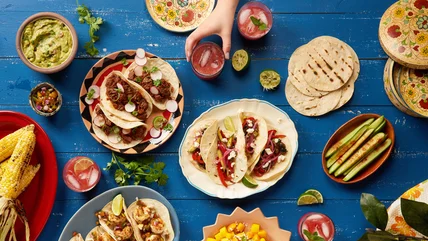
We're not running a restaurant here at CHOW.com, but we have found that recipes without pictures don't generate much interest. Seeing an image of a food you like makes you want it, and can even override hunger signals. So why wouldn't every restaurant put luscious food photos on the menu? It's not classy, say menu psychologists, with no evidence whatsoever. In fact, there's far more evidence to suggest that the volume and type of background music a restaurant plays has a much greater influence on what customers spend.
Myth: Being upfront about prices scares diners.
Here's a real sacred cow. "In the world of menu engineering and pricing, a dollar sign is pretty much the worst thing you can put on a menu, particularly at a high-end restaurant," asserted the New York Times in 2009. Some menus leave off prices altogether, particularly on specials, or finesse the pricing format, hoping to strike magic. But there's simply no evidence that hiding prices changes diner behavior, according to a Cornell study by Sybil Yang. The only thing pretty much everybody agrees about is just how much diners hate having to ask how much something costs.
Image source: Flickr member stevendepolo under Creative Commons
It's funny that people associate menus with pictures with cheap Chinese food, since that hasn't been my experience. I associate menus with pictures with places like Denny's.
There are a lot of pitfalls to having pictures of food. People will be unhappy if the dish they get doesn't look like the picture, and it makes it hard (and expensive) to change the menu. Most busy kitchens don't have time...+READ
It's funny that people associate menus with pictures with cheap Chinese food, since that hasn't been my experience. I associate menus with pictures with places like Denny's.
There are a lot of pitfalls to having pictures of food. People will be unhappy if the dish they get doesn't look like the picture, and it makes it hard (and expensive) to change the menu. Most busy kitchens don't have time to have do a photo shoot of their dishes every time they change them, nor can they afford to reprint high-quality photo menus frequently.-COLLAPSE
The last myth... I will never order the market price items on the menu. If the menu isn't upfront about the price, I am not going to ask as I'm envisioning a huge number automatically.
What I don't understand is the concept behind not having the desserts listed on the main menu. When restaurants come around with a dessert menu after I've eaten dinner, I'm usually too full to order more. If I knew ahead of time that there was a dessert item I'd like, I would probably have saved room.
Interesting topic.
There is more to "myths" when designing menus. In my opinion, it is true that there are small design nudges that can slightly modify customer behaviours under certain contexts, but this must also be supported by effective execution.
For example, I agree with @cowboyardee that we expect menu pictures, a) at a 'nicer' restaurant (context) b) have pictures that reflect their...+READ
Interesting topic.
There is more to "myths" when designing menus. In my opinion, it is true that there are small design nudges that can slightly modify customer behaviours under certain contexts, but this must also be supported by effective execution.
For example, I agree with @cowboyardee that we expect menu pictures, a) at a 'nicer' restaurant (context) b) have pictures that reflect their style, taste, and price point (execution).
Also, if we look at specific restaurants, certain types of clientele expect different menu compositions. Would be great if the authour could delve further into menu designs and innovations as well as debunking the myth!-COLLAPSE
My chief menu annoyance, especially prevalent in upscale or "foodie" joints, is the listing of major ingredients in a dish, often with some accompanying adjectives, with no indication of what the dish actually is. So it's got quail confit, artisan toast points, and some sort of wasabi bacon foam: is it a sammich, or what?
It's pretty much necessary in a lot of places to read a menu like a book...usually everything is organized in a way that you can read through appetizers/courses/etc and choose as you go, in the order you would eat them right through dessert.
As for pictures, nowadays it seems that most menus are available online. I usually take a look before I go and then if I need to look something up I can...+READ
It's pretty much necessary in a lot of places to read a menu like a book...usually everything is organized in a way that you can read through appetizers/courses/etc and choose as you go, in the order you would eat them right through dessert.
As for pictures, nowadays it seems that most menus are available online. I usually take a look before I go and then if I need to look something up I can do that and see pictures of it.-COLLAPSE
I don't expect pictures at the finer restaurants, but I DO want to see prices, as I, too, feel uncomfortable asking. And I do find photos enticing at "family" spots. They definitely influence what I decide to order.
if high end restaurants did include quality photos on their menus would this lead to a decline in "food-porn"cook book?
I also think of crappy Chinese restaurants that reek of old grease when I see pictures of food. I don't mind pictures of food on blogs or restaurant sites, but I would find pictures on a fine-dining menu gauche. I always feel I can't afford to eat at places that don't list their prices; I let my relatives take me to those places. On the whole, this study sounds rather silly.
Regarding the menu-reading study: I doubt that a highly controlled enviroment wherein one is TOLD specifically "read this menu." sheds any light on how individuals might read menus under a real world situation, in an actual restaurant of their own free will.
Infrared eyeball scanners? You're darn right I'd be reading that menu exactly as its written...
Red is a stimulating color that is used to quicken responses. NOT the appetite. Have you been to any fast food chain? They all liberally use that color. Usually so that you order quickly, eat quickly, and leave quickly. Or better yet have the items as takeout!
Pictures of food have their place on menus, but no high end restaurant would attempt such a feat w/o fear of a backlash. And we all know...+READ
Red is a stimulating color that is used to quicken responses. NOT the appetite. Have you been to any fast food chain? They all liberally use that color. Usually so that you order quickly, eat quickly, and leave quickly. Or better yet have the items as takeout!
Pictures of food have their place on menus, but no high end restaurant would attempt such a feat w/o fear of a backlash. And we all know that those pictures are produced in a studio. By a professional, and have no bearing on the actual product you consume. Because if they did EVERYONE would use this as a sales tactic. Isn't the idea of being in business to make money after all?
Prices are prices. And if you're price conscious you will always ask or look for those items which suit your budget. And if you're not....
Lastly there are studies and polls that can be found/manipulated to support any theory.
So the bottom line is to educate/know yourself and quit relying on what these supposed studies reveal.-COLLAPSE
I tend to associate photos of food on the menu with cheap Chinese restaurants
The purple thing has in fact been tested, though I read about it long ago and can't attest to the rigor of the tests.
wirth.jason and cowboyardee, thank you for the food for thought. Ha, I made a pun. See what I did there?
+1 to cowboyardee for deep insight into signaling. It reminds me of point made in Freakonomics where "upper class" people change their fashion once "lower class" people adopt the trend.
To the point about prices, this post implies that including or excluding the price doesn't change the amount diners spend at restaurants and incorrectly cites a Cornell study. The study didn't look at prices vs...+READ
+1 to cowboyardee for deep insight into signaling. It reminds me of point made in Freakonomics where "upper class" people change their fashion once "lower class" people adopt the trend.
To the point about prices, this post implies that including or excluding the price doesn't change the amount diners spend at restaurants and incorrectly cites a Cornell study. The study didn't look at prices vs no prices, it looked at the format of prices. From the abstract:
Price formats tested in the study were a dollars and cents numerical format with a dollar sign ($00.00), a numerical format without a dollar sign (00.), and scripted or written-out prices (zero dollars).
While I can't cite any specific studies including prices, and when the price is revealed in the sales process greatly influences consumer's behavior. I would suspect this applies to dining as well. After all, there must be a reason companies tout $1 Value Meals. Moreover, the influence may not be direct but could result from some complex signaling as cowboyardee pointed out.-COLLAPSE
Re: 'Myth: pictures of food are tacky"
You misunderstand the prevailing logic and fault the lack of supporting research when no research at all is needed to explain why menu writers suggest avoiding pictures for restaurants that emphasize the quality of their food. It's 'tacky' precisely because it is common at low-cost, low quality joints and uncommon at high-end restaurants. It's tacky by...+READ
Re: 'Myth: pictures of food are tacky"
You misunderstand the prevailing logic and fault the lack of supporting research when no research at all is needed to explain why menu writers suggest avoiding pictures for restaurants that emphasize the quality of their food. It's 'tacky' precisely because it is common at low-cost, low quality joints and uncommon at high-end restaurants. It's tacky by association, not by some complex mechanism of psychology.
The same logic doesn't apply to recipes or even necessarily to restaurant websites (where many nicer restaurants do indeed include pictures of their dishes) just because there is no pre-existing trend where pictures indicate lack of quality.-COLLAPSE